Monocyclic planar (or almost planar) systems of trigonally (or sometimes digonally) hybridized atoms that contain (4n + 2) ![[pi]](/img3/H_files/PI.gif) electrons (where n is a non-negative integer) will exhibit aromatic character. The rule is generally limited to n = 0-5.
electrons (where n is a non-negative integer) will exhibit aromatic character. The rule is generally limited to n = 0-5.
This rule is derived from the Hückel MO calculation on planar monocyclic conjugated hydrocarbons (CH)m where m is an integer equal to or greater than 3 according to which (4n + 2) electrons are contained in a closed-shell system. Examples of systems that obey the Hückel rule include:
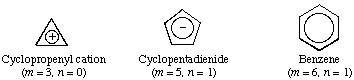
Systems containing 4n electrons (such as cyclobutadiene and the cyclopentadienyl cation) are "antiaromatic". See also conjugation, Möbius aromaticity.
