Electrophoresis is a separations technique that is based on the mobility of ions in an electric field.

Positively charged ions migrate towards a negative electrode and negatively charged ions migrate toward a positive electrode. For safety reasons one electrode is usually at ground and the other is biased positively or negatively.
Ions have different migration rates depending on their total charge, size, and shape, and can therefore be separated.
The technique is used particularly for macromolecules, such as proteins. A negative charge is added to these molecules so they move towards the positive electrode.
An electrode apparatus consists of a high-voltage supply, electrodes, buffer, and a support for the buffer such as filter paper, cellulose acetate strips, polyacrylamide gel, or a capillary tube.
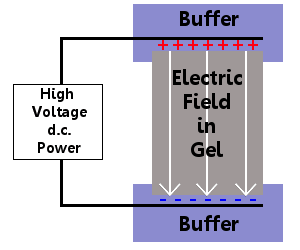
Open capillary tubes are used for many types of samples and the other supports are usually used for biological samples such as protein mixtures or DNA fragments. After a separation is completed the support is stained to visualize the separated components.
Resolution can be greatly improved using isoelectric focusing. In this technique the support gel maintains a pH gradient. As a protein migrates down the gel, it reaches a pH that is equal to its isoelectric point. At this pH the protein is neutral and no longer migrates, i.e., it is focused into a sharp band on the gel.
Specific electrophoretic techniques
- disc electrophoresis
- capillary electrophoresis
- gel electrophoresis