The chemical element antimony is classed as a metalloid. It has been known in its elemental state since the 1500s. Its discoverer and discovery date are unknown.

Data Zone
| Classification: | Antimony is a metalloid |
| Color: | silvery white |
| Atomic weight: | 121.760 |
| State: | solid |
| Melting point: | 630.79 oC, 903.94 K |
| Boiling point: | 1587 oC, 1860 K |
| Electrons: | 51 |
| Protons: | 51 |
| Neutrons in most abundant isotope: | 70 |
| Electron shells: | 2,8,18,18,5 |
| Electron configuration: | [Kr] 4d10 5s2 5p3 |
| Density @ 20oC: | 6.684 g/cm3 |
Compounds, Radii, Conductivities
| Atomic volume: | 18.22 cm3/mol |
| Structure: | rhombohedral |
| Hardness: | 3.15 mohs |
| Specific heat capacity | 0.21 J/gK |
| Heat of fusion | 19.870 kJ mol-1 |
| Heat of atomization | 262 kJ mol-1 |
| Heat of vaporization | 67.97 kJ mol-1 |
| 1st ionization energy | 833.7 kJ mol-1 |
| 2nd ionization energy | 1594.9 kJ mol-1 |
| 3rd ionization energy | 2441.1 kJ mol-1 |
| Electron affinity | 103 kJ mol-1 |
| Minimum oxidation number | -3 |
| Min. common oxidation no. | 0 |
| Maximum oxidation number | 5 |
| Max. common oxidation no. | 5 |
| Electronegativity (Pauling Scale) | 2.05 |
| Polarizability volume | 6.6 Å3 |
| Reaction with air | mild, w/ht, ⇒ Sb2Ox x=3-5 |
| Reaction with 15 M HNO3 | mild, ⇒ Sb2O5 |
| Reaction with 6 M HCl | none |
| Reaction with 6 M NaOH | none |
| Oxide(s) | Sb2O3 Sb2O4 Sb2O5 |
| Hydride(s) | SbH3 |
| Chloride(s) | SbCl3 SbCl5 |
| Atomic radius | 140 pm |
| Ionic radius (1+ ion) | – |
| Ionic radius (2+ ion) | – |
| Ionic radius (3+ ion) | 90 pm |
| Ionic radius (1- ion) | – |
| Ionic radius (2- ion) | – |
| Ionic radius (3- ion) | – |
| Thermal conductivity | 24.4 W m-1 K-1 |
| Electrical conductivity | 2.5641 x 10⁶ S m-1 |
| Freezing/Melting point: | 630.79 oC, 903.94 K |
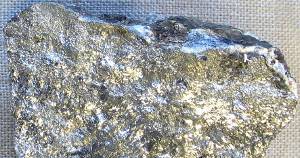
Native, natural antimony. Photo by Aram Dulyan
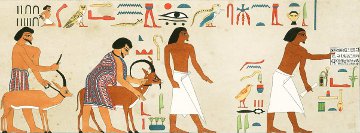
Ancient Egyptian hieroglyphs dating from about 1890 BC at the top of this wall painting say: “The arrival, bringing stibium.” (9) It is likely that the Egyptian word for stibium was mestchem-t. (10) Mural drawing: Karl Richard Lepsius.
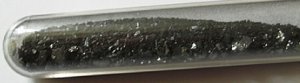
Antimony’s black allotrope – an amorphous metastable form of the element formed by cooling gaseous antimony rapidly. It is more chemically reactive than the metallic form of the element. (11)
Discovery of Antimony
People have been making use of antimony’s compounds for thousands of years. We know that one of antimony’s minerals, stibnite (Sb2S3), was used in Egyptian cosmetics four or five thousand years ago as a black eyeliner. (1)
It is likely that the Roman author Pliny used the name stibium in the first century AD. We get the modern element symbol for antimony, Sb, from the word stibium. According to Pliny, the mineral stibnite was found most commonly among silver ores.
Pliny described how stibnite could be used as a medicine and how, if heated too strongly, it would turn to lead. We understand now that the ‘lead’ described by Pliny is actually the element antimony, produced by heating its ore. (2)
In the first half of the 1500s, Italian metallurgist Vannoccio Biringuccio wrote the alchemical work: “Concerning Antimony and Its Ore.” He describes antimony sulfide as either “a monstrosity among metals” or “a material that is about to reach metallic perfection, but is hindered from doing so by being mined too soon.” [This was not chemistry as we know it!]
Biringuccio does get it right when he warns against heating antimony sulfide too strongly, because this will produce a substance that, “although this is very white and almost more shining than silver, it is much more brittle than glass.” This is a clear description of the element antimony. (3)
Clearly alchemists had produced antimony in its elemental state by the 1500s.
French chemist Nicolas Lémery wrote his Treatise on Antimony in 1707 and took a scientific leap — backwards. In his writings, Lémery describes how acids prick the tongue because they contain spiky particles, while metals dissolve in acids because the sharp points of acids tear the metal particles apart. (4)
The name “antimony” is derived from two Greek words: ‘anti’ and ‘monos’ which mean ‘not alone.’
The name was given because antimony is rarely found native; it is usually combined with sulfur or with heavier metals such as copper, lead and silver.
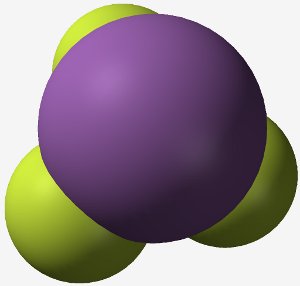
Molecular model of the highly toxic stibine (antimony trihydride). (Image: Ben Mills)
Appearance and Characteristics
Harmful effects:
Like arsenic, which sits directly above it in the periodic table, the toxicity of antimony and its compounds varies according to the chemical state of the element. Many of the salts are carcinogenic.
The metallic form is considered to be less active whereas stibine (SbH3) and stibnite (Sb2S3) are extremely toxic.(5) Antimony is toxic and immediately dangerous to life or health at 50 mg m-3 or above. (6)
Exposure to 9 milligrams per cubic meter of air (mg/m3) of antimony as stibnite for a long time can irritate your eyes, skin, and lungs. Breathing 2 mg/m3 of antimony for a long time can cause problems with the lungs (pneumoconiosis) heart problems (altered electrocardiograms), stomach pain, diarrhea, vomiting and stomach ulcers. People who drank over 19 ppm of antimony in one sitting vomited. (7)
Characteristics:
Antimony is metalloid, so it has some metallic properties but not enough to be classified as a true metal. Physically, it behaves like sulfur while chemically it is more metallic. (1)
Antimony’s electrical and thermal conductivity are lower than most metals’ conductivities.
Antimony is a brittle, fusible, crystalline solid. It is easily powdered.
Antimony also has the unusual property that (like water) it expands as it freezes. Four other elements expand when they freeze; silicon, bismuth, gallium and germanium.
In addition to the usual form of antimony, there are three allotropes: yellow crystalline, amorphous black, and explosive.
Uses of Antimony
The major use of antimony is in lead alloys – mainly for use in batteries – adding hardness and smoothness of finish. The higher the proportion of antimony in the alloy, the harder and more brittle it will be. Alloys made with antimony expand on cooling, retaining the finer details of molds. Antimony alloys are therefore used in making typefaces for clear, sharp printing.
Babbit metals, used for machinery bearings, are alloys of lead, tin, copper and antimony. These metals are hard but slippery and so ideal for use as bearings. (8)
Antimony is used in the semiconductor industry as an n-type dopant for silicon.
Antimony trioxide is used as a flame retardant in adhesives, plastics, rubber and textiles.
Abundance and Isotopes
Abundance earth’s crust: 0.2 parts per million by weight, 0.03 parts per million by moles
Abundance solar system: 950 parts per billion by weight, 10 parts per trillion by moles
Cost, pure: $4.5 per 100g
Cost, bulk: $0.44 per 100g
Source: Most antimony is produced from stibnite (antimony sulfide, Sb2S3). It is also extracted as a byproduct of copper, gold and silver production.
Isotopes: 31 whose half-lives are known, mass numbers 104 to 136. Of these, two are stable and found naturally in the percentages shown: 121Sb (57.36%) and 123Sb (42.64%).
References
- Robert E. Krebs, The history and use of our earth’s chemical elements: a reference guide., (2006) p219. Greenwood Publishing Group
- Thomas Thomson, The history of chemistry, Volume 1, (1830) p74. (ebook digitized by Google)
- Vannoccio Biringuccio, The Pirotechnia of Vannoccio Biringuccio, translated by Cyril Stanley Smith and Martha Teach Gnudi, (1990) p201. Dover Publications
- Mahadev M. Kumbar, Chemistry in a Day of Student’s Life, (2003) p179. iUniverse
- http://www.nrc-cnrc.gc.ca/eng/education/elements/el/sb.html
- http://www.osha.gov/dts/chemicalsampling/data/CH_219100.html
- http://www.atsdr.cdc.gov/toxprofiles/tp23.pdf
- George Stuart Brady, Henry R. Clauser, John A. Vaccari Materials Handbook., (2002) p74. McGraw Hill Professional
- Jeffrey H. Tigay, Introduction to the Bible
- Sir Ernest Alfred Wallis Budge, An Egyptian hieroglyphic dictionary., 1978, p329, Dover Publications.
- Chung Yu Wagn, Antimony, 1919, p10-12, Charles Griffin and Co. Ltd. (pdf document).
Cite this Page
For online linking, please copy and paste one of the following:
<a href="https://www.chemicool.com/elements/antimony.html">Antimony</a>
or
<a href="https://www.chemicool.com/elements/antimony.html">Antimony Element Facts</a>
To cite this page in an academic document, please use the following MLA compliant citation:
"Antimony." Chemicool Periodic Table. Chemicool.com. 15 Oct. 2012. Web. <https://www.chemicool.com/elements/antimony.html>.