The chemical element arsenic is classed as a metalloid. It has been known since ancient times. Its discoverer and discovery date are unknown.

Data Zone
| Classification: | Arsenic is a metalloid |
| Color: | gray |
| Atomic weight: | 74.9216 |
| State: | solid |
| Melting point: | 817 oC, 1090 K |
| Note: At normal atmospheric pressure arsenic does not melt when heated, it sublimes. i.e. when heated, arsenic undergoes a phase change directly from solid to gas. The melting point quoted above is for gray arsenic under a pressure of 28 atmospheres. |
|
| Boiling point: | 603 oC, 876 K |
| Electrons: | 33 |
| Protons: | 33 |
| Neutrons in most abundant isotope: | 42 |
| Electron shells: | 2,8,18,5 |
| Electron configuration: | [Ar] 3d10 4s2 4p3 |
| Density @ 20oC: | 5.776 g/cm3 |
Compounds, Radii, Conductivities
| Atomic volume: | 12.97 cm3/mol |
| Structure: | rhombohedral; layers of 6-member rings |
| Hardness: | 3.5 mohs |
| Specific heat capacity | 0.33 J g-1 K-1 |
| Heat of fusion | 24.44 kJ mol-1 |
| Heat of atomization | 303 kJ mol-1 |
| Heat of vaporization | 32.4 kJ mol-1 |
| 1st ionization energy | 946.5 kJ mol-1 |
| 2nd ionization energy | 1797.8 kJ mol-1 |
| 3rd ionization energy | 2735.4 kJ mol-1 |
| Electron affinity | 78 kJ mol-1 |
| Minimum oxidation number | -3 |
| Min. common oxidation no. | -3 |
| Maximum oxidation number | 5 |
| Max. common oxidation no. | 5 |
| Electronegativity (Pauling Scale) | 2.18 |
| Polarizability volume | 4.3 Å3 |
| Reaction with air | mild, w/ht ⇒ As4O6 |
| Reaction with 15 M HNO3 | mild, w/ht ⇒ H3AsO4, NOx |
| Reaction with 6 M HCl | none |
| Reaction with 6 M NaOH | none |
| Oxide(s) | As2O3 |
| Hydride(s) | AsH3 |
| Chloride(s) | AsCl3 AsCl5 |
| Atomic radius | 115 pm |
| Ionic radius (1+ ion) | – |
| Ionic radius (2+ ion) | – |
| Ionic radius (3+ ion) | 72 pm |
| Ionic radius (1- ion) | – |
| Ionic radius (2- ion) | – |
| Ionic radius (3- ion) | – |
| Thermal conductivity | 50.2 W m-1 K-1 |
| Electrical conductivity | 3.85 x 10⁶ S m-1 |
| Freezing/Melting point: | 817 oC, 1090 K |
Discovery of Arsenic
Arsenic has been known since antiquity in its sulfide compound.
Greek philosopher Aristotle, in the fourth century BC, refers to “sandarach” renamed arhenicum by his student Theophrastus of Eresos.
Greek historian Olympiodorus of Thebes (5th century AD) roasted arsenic sulfide and obtained white arsenic (As2O3).
Albertus Magnus (1193-1280), a German philosopher and theologian, was the first to state that arsenic has a metal-like nature. In De Mineralibus he described how the metal could be obtained by heating orpiment (As2S3) with soap.
Two methods of preparing arsenic were published by German pharmacist Johann Schroeder in 1649.
The element name is believed to come from the Greek word ‘arsenikos’ meaning potent.
The image below shows a bottle of arsenious acid – a poison.
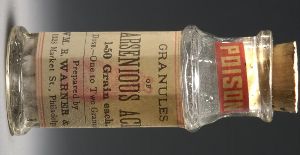

An old government warning poster.
Appearance and Characteristics
Harmful effects:
Arsenic is immediately dangerous to life or health at 5 mg m-3.
Our bodies do not readily absorb the element itself, hence pure arsenic is much less dangerous than As(III) compounds such as AsH3 and As2O3 which are absorbed easily and are carcinogenic with high toxicity.
Characteristics:
Arsenic occurs in three distinct solid forms.
Gray arsenic is the most common. It has a metallic sheen and conducts electricity.
Yellow arsenic is metastable, is a poor electrical conductor and does not have a metallic sheen. It is prepared by cooling gray arsenic vapor in liquid air. It reverts to gray arsenic at room temperature.
Black arsenic can be prepared by cooling arsenic vapor at 100 oC – 200 oC. It is glassy, brittle and a poor electrical conductor.
Uses of Arsenic
As a result of its toxicity, arsenic compounds are used in wood preservation and insecticides.
Gallium arsenide (GaAs) is a semiconductor used in laser diodes and LEDs.
Small amounts of arsenic (less than two percent) can be used in lead alloys for ammunition.
Despite its potential toxicity, arsenic is also an essential element, necessary to our physiology. A level of 0.00001% is needed for growth and for a healthy nervous system.
Abundance and Isotopes
Abundance earth’s crust: 1.8 parts per million by weight, 0.5 parts per million by moles
Abundance solar system: 12 parts per billion by weight, 0.21 parts per billion by moles
Cost, pure: $320 per 100g
Cost, bulk: $ per 100g
Source: Most arsenic is obtained as a by-product of processing gold, silver, copper, and other metal ores.
Isotopes: Arsenic has 23 isotopes whose half-lives are known, with mass numbers 65 to 87. Of these, only one is stable: 75As.
Cite this Page
For online linking, please copy and paste one of the following:
<a href="https://www.chemicool.com/elements/arsenic.html">Arsenic</a>
or
<a href="https://www.chemicool.com/elements/arsenic.html">Arsenic Element Facts</a>
To cite this page in an academic document, please use the following MLA compliant citation:
"Arsenic." Chemicool Periodic Table. Chemicool.com. 15 Oct. 2012. Web. <https://www.chemicool.com/elements/arsenic.html>.
Thank you soo much for the information on Arsenic! I had to do an element project for chemistry and this was perfect for the assignment.
Thanks i had to do a project on this element for my science class and i must admit this was great information thanks soooooo much!
Thanks for the info I had to do a project. This is a good site!
Thanks a bunch, I needed the info for class. There was so much info found here that really helped in my research. ^w^
can arsenic levels be lowered in borates if heated in a furnace at a high enough temperature?
thanks for the facts