The chemical element germanium is classed as a metalloid. It was discovered in 1886 by Clemens A. Winkler.

Data Zone
| Classification: | Germanium is a metalloid |
| Color: | gray-white |
| Atomic weight: | 72.64 |
| State: | solid |
| Melting point: | 938 oC, 1210.6 K |
| Boiling point: | 2830 oC, 3103 K |
| Electrons: | 32 |
| Protons: | 32 |
| Neutrons in most abundant isotope: | 42 |
| Electron shells: | 2,8,18,4 |
| Electron configuration: | [Ar] 3d10 4s2 4p2 |
| Density @ 20oC: | 5.323 g/cm3 |
Reactions, Compounds, Radii, Conductivities
| Atomic volume: | 13.6 cm3/mol |
| Structure: | diamond structure |
| Hardness: | 6 mohs |
| Specific heat capacity | 0.32 J g-1 K-1 |
| Heat of fusion | 36.940 kJ mol-1 |
| Heat of atomization | 377 kJ mol-1 |
| Heat of vaporization | 334.3 kJ mol-1 |
| 1st ionization energy | 762.1 kJ mol-1 |
| 2nd ionization energy | 1537.4 kJ mol-1 |
| 3rd ionization energy | 3301.7 kJ mol-1 |
| Electron affinity | 120 kJ mol-1 |
| Minimum oxidation number | -4 |
| Min. common oxidation no. | -4 |
| Maximum oxidation number | 4 |
| Max. common oxidation no. | 4 |
| Electronegativity (Pauling Scale) | 2.01 |
| Polarizability volume | 6.1 Å3 |
| Reaction with air | mild, w/ht ⇒ GeO2 |
| Reaction with 15 M HNO3 | mild, ⇒ Geiv, NOx |
| Reaction with 6 M HCl | none |
| Reaction with 6 M NaOH | none |
| Oxide(s) | GeO, GeO2 |
| Hydride(s) | GeH4, Ge2H6 + more |
| Chloride(s) | GeCl2, GeCl4 |
| Atomic radius | 122.3 pm |
| Ionic radius (1+ ion) | – |
| Ionic radius (2+ ion) | 87 pm |
| Ionic radius (3+ ion) | – |
| Ionic radius (1- ion) | – |
| Ionic radius (2- ion) | – |
| Ionic radius (3- ion) | – |
| Thermal conductivity | 60.2 W m-1 K-1 |
| Electrical conductivity | 3 S m-1 |
| Freezing/Melting point: | 938 oC, 1210.6 K |
Discovery of Germanium
Germanium was one of the elements whose existence was predicted in 1869 by Russian chemist Dmitri Mendeleev, after he noticed a gap between silicon and tin in his periodic table. Mendeleev provisionally called the predicted element eka-silicon.
Germanium was discovered by Clemens A. Winkler in 1886, in Germany, in a mineral sample from a silver mine.
Analysis indicated the sample – a rather rare mineral called argyrodite – contained 73 – 75% silver, 17 – 18% sulfur, 0.2% mercury, and 6 – 7% a new element, which Winkler named germanium.
Mendeleev had predicted the new element’s density would be 5.5 g/cm3 and its atomic weight would be 70.
His predictions proved to be rather good.
Winkler’s name for the element comes from the Latin ‘Germania’ meaning Germany.
Appearance and Characteristics
Harmful effects:
Germanium is not known to be toxic.
Characteristics:
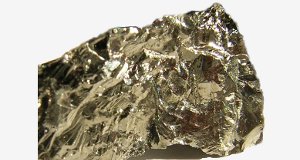
Germanium is a lustrous, hard, gray-white semi-metallic element with a crystalline and brittle structure.
It is a semiconductor.
Germanium and the oxide are transparent to infrared radiation.
Germanium also has the unusual property that (like water) it expands as it freezes.
Four other elements expand when they freeze; silicon, bismuth, antimony and gallium.
Uses of Germanium
The most common use of germanium is as a semiconductor.
Germanium is used in transistors and in integrated circuits.
It is used as an alloying agent and as a catalyst.
It is also used in infrared spectroscopes and infrared detectors.
Some germanium compounds are useful because they are toxic to bacteria but are harmless for mammals.
Abundance and Isotopes
Abundance earth’s crust: 1.5 parts per million by weight, 0.42 parts per million by moles
Abundance solar system: 200 parts per billion by weight, 3 parts per billion by moles
Cost, pure: $360 per100g
Cost, bulk: $120 per 100g
Source: The main ore of germanium is germanite, which is about 7% germanium. Commercially, germanium is obtained as a byproduct of metal refining and from some coal ashes.
Isotopes: Germanium has 24 isotopes whose half-lives are known, with mass numbers 58 to 85. Naturally occurring germanium is a mixture of five isotopes and they are found in the percentages shown: 70Ge (21.2%), 72Ge (27.7%), 73Ge (7.7%), 74Ge (35.9%) and 76Ge (7.4%). The most abundant is 74Ge at 35.9%.
References
- Photo: Gibe, GNU Free Documentation License.
Cite this Page
For online linking, please copy and paste one of the following:
<a href="https://www.chemicool.com/elements/germanium.html">Germanium</a>
or
<a href="https://www.chemicool.com/elements/germanium.html">Germanium Element Facts</a>
To cite this page in an academic document, please use the following MLA compliant citation:
"Germanium." Chemicool Periodic Table. Chemicool.com. 26 Jul. 2014. Web. <https://www.chemicool.com/elements/germanium.html>.
This is the best website ever it really helps!!!!!!
awesome site
give us the answers
Give us the questions.