The chemical element ruthenium is classed as a transition metal. It was discovered in 1844 by Karl K. Klaus.

Data Zone
| Classification: | Ruthenium is a transition metal |
| Color: | silvery-white |
| Atomic weight: | 101.07 |
| State: | solid |
| Melting point: | 2330 oC, 2603 K |
| Boiling point: | 4150 oC, 4423 K |
| Electrons: | 44 |
| Protons: | 44 |
| Neutrons in most abundant isotope: | 58 |
| Electron shells: | 2,8,18,15,1 |
| Electron configuration: | [Kr] 4d7 5s1 |
| Density @ 20oC: | 12.2 g/cm3 |
Reactions, Compounds, Radii, Conductivities
| Atomic volume: | 8.3 cm3/mol |
| Structure: | hcp: hexagonal close pkd |
| Hardness: | 6.5 mohs |
| Specific heat capacity | 0.238 J g-1 K-1 |
| Heat of fusion | 24.0 kJ mol-1 |
| Heat of atomization | 652 kJ mol-1 |
| Heat of vaporization | 595.0 kJ mol-1 |
| 1st ionization energy | 711.1 kJ mol-1 |
| 2nd ionization energy | 1617.1 kJ mol-1 |
| 3rd ionization energy | 2746.9 kJ mol-1 |
| Electron affinity | 101 kJ mol-1 |
| Minimum oxidation number | -2 |
| Min. common oxidation no. | 0 |
| Maximum oxidation number | 8 |
| Max. common oxidation no. | 4 |
| Electronegativity (Pauling Scale) | 2.2 |
| Polarizability volume | 9.6 Å3 |
| Reaction with air | w/ht, ⇒ RuO4 |
| Reaction with 15 M HNO3 | w/ht, ⇒ RuO4 |
| Reaction with 6 M HCl | none |
| Reaction with 6 M NaOH | none |
| Oxide(s) | RuO2, RuO4 |
| Hydride(s) | – |
| Chloride(s) | RuCl2, RuCl3 |
| Atomic radius | 134 pm |
| Ionic radius (1+ ion) | – |
| Ionic radius (2+ ion) | – |
| Ionic radius (3+ ion) | 82 pm |
| Ionic radius (1- ion) | – |
| Ionic radius (2- ion) | – |
| Ionic radius (3- ion) | – |
| Thermal conductivity | 117 W m-1 K-1 |
| Electrical conductivity | 14.9 x 10⁶ S m-1 |
| Freezing/Melting point: | 2330 oC, 2603 K |
Discovery of Ruthenium
Ruthenium was the last of the six platinum group metals (platinum, palladium, rhodium, osmium, iridium and ruthenium) to be discovered.
The initial discovery of ruthenium was thought to have occurred in 1828, when Swedish chemist Jons Jacob Berzelius and Russian chemist Gottfried W. Osann examined the residues left from crude platinum ores after dissolving them in aqua regia (a concentrated solution of hydrochloric and nitric acids).
Osann believed that there were three new metals in these residues, which he called pluranium, polinium and ruthenium. Berzelius was, however, skeptical.
Later, in 1844, in Kazan, Russia, Karl K. Klaus repeated Osann’s work to clarify the results. He proved that there was only one new metal present in the residues. He kept Osann’s name of ruthenium for this new metal.
Klaus used a lengthy process to obtain the salt, ammonium chlororuthenate, (NH4)2RuCl6, from which he could isolate the metal ruthenium and identify its properties. (1)
The element’s name comes from the Latin word ‘Ruthenia’ meaning Russia, as the platinum ores were originally from the Ural Mountains in Russia.
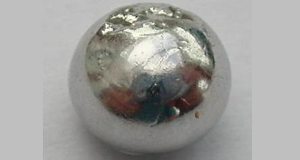
Below is a photo, by Tomihahndorf, of a 1 gram bead of high-purity ruthenium.
Appearance and Characteristics
Harmful effects:
Ruthenium is a suspected carcinogen and its compounds strongly stain the skin. Ruthenium tetroxide (RuO4) is highly toxic.
Characteristics:
Ruthenium is a very rare, hard, lustrous, brittle, silvery-white metal that does not tarnish at room temperature.
Typical of transition metals, ruthenium can exist in many oxidation states, its most common being the oxidation states II, III and IV.
The metal is unaffected by air, water and acids.
It reacts with molten alkali and halogens and can oxidize explosively.
Uses of Ruthenium
Small amounts of ruthenium are used to harden platinum and palladium and it can also be alloyed with these metals to make electrical contacts for severe wear resistance.
The addition of 0.1% ruthenium improves the corrosion resistance of titanium a hundred times over.
Ruthenium has catalytic properties; for example, hydrogen sulfide can be split by light in the presence of an aqueous suspension of cadmium sulfide particles loaded with ruthenium dioxide.
Interestingly, ruthenium is used in some Parker pen nibs, such as the Parker 51 whose nib is marked ‘RU’, and consists of 96.2% ruthenium and 3.8% iridium(2).
Abundance and Isotopes
Abundance earth’s crust: 1 part per billion by weight, 0.2 parts per billion by moles
Abundance solar system: 5 parts per billion by weight, 0.06 parts per billion by moles
Cost, pure: $1400 per 100g
Cost, bulk: $650 per 100g
Source: Ruthenium is found free in nature often with the other platinum group metals. Commercially, it is obtained from pentlandite (a sulfide of iron and nickel) which contains small quantities of ruthenium.
Ruthenium can also be extracted from spent nuclear fuel, however if obtained this way it will contain radioactive isotopes. It has to be stored safely for at least ten years until the radioactive isotopes have decayed.
Isotopes: Ruthenium has 26 isotopes whose half-lives are known, with mass numbers from 90 to 115. Naturally occurring ruthenium is a mixture of seven isotopes and they are found in the percentages shown: 96Ru (5.5%), 98Ru (1.9%), 99Ru (12.8%), 100Ru (12.6%), 101Ru (17.1%), 102Ru (31.6%), and104Ru (18.6%). Naturally, the most common isotope is 102Ru with an abundance of 31.6%.
References
- Mary Elvira Weeks, The Discovery of the Elements. VIII. The Platinum Metals., J. Chem. Educ., June 1932, p1028-1032.
- The Nibster – Where’s The Iridium?
Cite this Page
For online linking, please copy and paste one of the following:
<a href="https://www.chemicool.com/elements/ruthenium.html">Ruthenium</a>
or
<a href="https://www.chemicool.com/elements/ruthenium.html">Ruthenium Element Facts</a>
To cite this page in an academic document, please use the following MLA compliant citation:
"Ruthenium." Chemicool Periodic Table. Chemicool.com. 18 Oct. 2012. Web. <https://www.chemicool.com/elements/ruthenium.html>.