The chemical element barium is classed as an an alkali earth metal. It was discovered in 1774 by Carl W. Scheele.

Data Zone
| Classification: | Barium is an alkali earth metal |
| Color: | silvery white |
| Atomic weight: | 137.33 |
| State: | solid |
| Melting point: | 725 oC, 998.2 K |
| Boiling point: | 1897 oC, 2170 K |
| Electrons: | 56 |
| Protons: | 56 |
| Neutrons in most abundant isotope: | 82 |
| Electron shells: | 2,8,18,18,8,2 |
| Electron configuration: | [Xe] 6s2 |
| Density @ 20oC: | 3.59 g/cm3 |
Compounds, Radii, Conductivities
| Atomic volume: | 39.24 cm3/mol |
| Structure: | bcc: body-centered cubic |
| Hardness: | 1.25 mohs |
| Specific heat capacity | 0.204 J g-1 K-1 |
| Heat of fusion | 7.12 kJ mol-1 |
| Heat of atomization | 182 kJ mol-1 |
| Heat of vaporization | 140.3 kJ mol-1 |
| 1st ionization energy | 502.9 kJ mol-1 |
| 2nd ionization energy | 965.2 kJ mol-1 |
| 3rd ionization energy | 3600 kJ mol-1 |
| Electron affinity | 14 kJ mol-1 |
| Minimum oxidation number | 0 |
| Min. common oxidation no. | 0 |
| Maximum oxidation number | 2 |
| Max. common oxidation no. | 2 |
| Electronegativity (Pauling Scale) | 0.89 |
| Polarizability volume | 39.7 Å3 |
| Reaction with air | vigorous, w/ht ⇒ BaO, Ba2N3 |
| Reaction with 15 M HNO3 | mild, ⇒ Ba(NO3)2 |
| Reaction with 6 M HCl | vigorous, ⇒ H2, BaCl2 |
| Reaction with 6 M NaOH | passivated |
| Oxide(s) | BaO, BaO2 |
| Hydride(s) | BaH2 |
| Chloride(s) | BaCl2 |
| Atomic radius | 215 pm |
| Ionic radius (1+ ion) | – |
| Ionic radius (2+ ion) | 149 pm |
| Ionic radius (3+ ion) | – |
| Ionic radius (1- ion) | – |
| Ionic radius (2- ion) | – |
| Ionic radius (3- ion) | – |
| Thermal conductivity | 18.4 W m-1 K-1 |
| Electrical conductivity | 2.8 x 10⁶ S m-1 |
| Freezing/Melting point: | 725 oC, 998.2 K |
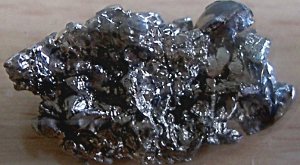
Barium. Photo by Matthias Zepper.
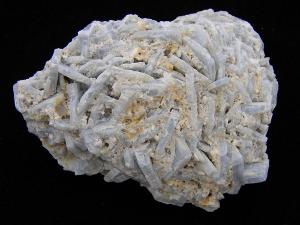
Barium was first discovered in barite, also known as barium sulfate. This mineral attracted attention in the 17th century, when it was found to radiate red light after heating. Image from Missouri Dept. of Natural Resources.
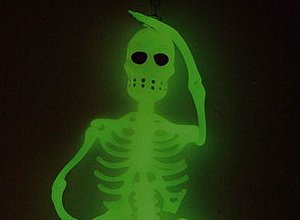
When Vincentius Casciorolus saw rocks that glowed in the dark, he thought he might be looking at the philosopher’s stone. Nowadays, nearly everyone has seen phosphorescent materials in action. Image by Luu Ly.
Discovery of Barium
In the early 1600s, Vincentius Casciorolus, a shoemaker with an interest in alchemy, was excited. He had learned there was a heavy, silvery-white mineral with remarkable properties in the mountains near Bologna, Italy. Perhaps, he thought, it might even be the philosopher’s stone.
When the mineral was heated and combusted, its product emitted a phosphorescent red glow – very neat. But what really excited Casciorolus – and others – was that if the combusted material was exposed to sunshine, it would glow in the dark for up to an hour afterwards.
We now know that the silvery white mineral was impure barium sulfate, BaSO4. After heating, it became impure barium sulfide, BaS. (1), (2), (3), (4)
Sadly for Casciorolus, although this material’s properties were interesting, it proved useless as a means of making gold from other metals and failed to make him immortal. Rather than ‘philosopher’s stone’ it became known as ‘Bologna stone’ – a curiosity.
Sadly, also, no-one took the opportunity to discover the new element present in Bologna stone. Of course, at the time, nobody suspected there were any new elements to be discovered!
About 170 years passed before barium was first recognized as a new element by Swedish scientist Carl W. Scheele. Investigating magnesium oxide in 1774, Scheele found a new earth metal: “an earth differing from all earths hithero known.” He called this new metal ‘terra ponderosa.’ (Latin: heavy earth.)
A comparison was made with Bologna stone, and the two were found to contain the same substance. (Until this point, people had thought Bologna stone was a compound of calcium. (2))
Barium metal was isolated for the first time in 1808 by English chemist Sir Humphrey Davy in London. Davy followed the advice of Swedish chemist Jacob Berzelius, who had told him that barium sulfate could be decomposed by electrolysis. This was correct, and Davy isolated strontium in a similar way. The experimental details are on our strontium page.
The element was called barium because it was found in barite (barium sulfate) a mineral given its name because of its high density. The Greek ‘barys’ means heavy.
Barium’s Periodic Table Neighborhood
| Group 1 | Group 2 | Group 3 | |
| 5 | 37 Rb |
38 Sr |
39 Y |
| 6 | 55 Cs |
56 Ba |
57 La |
| 7 | 87 Fr |
88 Ra |
89 Ac |
Appearance and Characteristics
Harmful effects:
Barium compounds that are water or acid soluble are highly poisonous. Barium powder can ignite spontaneously in air.
Barium sulfate, used in x-ray imaging, is highly insoluble in water, and is therefore nontoxic and completely removed from the digestive tract.
Characteristics:
Barium is a metallic element chemically resembling calcium but more reactive. It is a soft, silvery metal and when cut it quickly turns a black color due to the formation of barium oxide, (BaO).
It is also highly reactive with water or alcohol.
When present in compounds barium exists usually in the Ba2+, divalent state.
Barium dissolves in most aqueous acids. The exception is sulfuric acid, due to the formation of an insoluble protective layer of barium sulfate.
Barium is most commonly found as the mineral barite (BaSO4) and witherite (BaCO3)
Uses of Barium
Barium is used as a “flashed getter” in vacuum tubes to remove the last traces of gases.
Barium is an important element in yttrium barium copper oxide (YBCO) superconductors.
An alloy of barium with nickel is used in sparkplug wire.
Barium sulfate (barite) is used to increase the contrast in x-ray imaging of the digestive system.
Abundance and Isotopes
Abundance earth’s crust: 425 parts per million by weight, 41 parts per million by moles
Abundance solar system: parts per billion by weight, parts per billion by moles
Cost, pure: $55 per 100g
Cost, bulk: $ per 100g
Source: Commercially obtained from the electrolysis of molten Barium Chloride, BaCl2
Isotopes: Barium has 37 isotopes. Naturally occurring barium is a mixture of seven stable isotopes and they are found in the percentages shown:
138Ba (71.7%), 137Ba (11.2%), 136Ba (7.9%), 135Ba (6.6%), 134Ba (2.4%), 130Ba (0.1%) and 132Ba (0.1%).
Of the radioactive isotopes, 133Ba is the longest lived with a half-life of 10.51 years.
References
- Mary Elvira Weeks, The Discovery of the Elements. X. The Alkaline Earth Metals and Magnesium and Cadmiun, Journal of Chemical Education., June 1932, p1050.
- J.W. Mellor, A Comprehensive Treatise on Inorganic and Theoretical Chemistry, Volume III, 1928, Longmans, Green and Co. Ltd, p619-621
- Thomas Lamb Phipson, Phosphorescence: or, The emission of light by minerals, plants, and animals., L. Reeve & co., 1862, p12.
- James L. Marshall and Virginia R. Marshall, Rediscovery of The Elements Phosphoro di Bologna., University of North Texas., p1.
Cite this Page
For online linking, please copy and paste one of the following:
<a href="https://www.chemicool.com/elements/barium.html">Barium</a>
or
<a href="https://www.chemicool.com/elements/barium.html">Barium Element Facts</a>
To cite this page in an academic document, please use the following MLA compliant citation:
"Barium." Chemicool Periodic Table. Chemicool.com. 15 Oct. 2012. Web. <https://www.chemicool.com/elements/barium.html>.
Love this site great videos