The chemical element zirconium is classed as a transition metal. It was discovered in 1789 by Martin Heinrich Klaproth.

Data Zone
| Classification: | Zirconium is a transition metal |
| Color: | grayish-white |
| Atomic weight: | 91.22 |
| State: | solid |
| Melting point: | 1850 oC, 2123 K |
| Boiling point: | 4400 oC, 4673 K |
| Electrons: | 40 |
| Protons: | 40 |
| Neutrons in most abundant isotope: | 50 |
| Electron shells: | 2,8,18,10,2 |
| Electron configuration: | [Kr] 4d2 5s2 |
| Density @ 20oC: | 6.52 g/cm3 |
Reactions, Compounds, Radii, Conductivities
| Atomic volume: | 14.0 cm3/mol |
| Structure: | hcp: hexagonal close packed |
| Hardness: | 5.0 mohs |
| Specific heat capacity | 0.27 J g-1 K-1 |
| Heat of fusion | 16.90 kJ mol-1 |
| Heat of atomization | 609 kJ mol-1 |
| Heat of vaporization | 590.5 kJ mol-1 |
| 1st ionization energy | 640.1 kJ mol-1 |
| 2nd ionization energy | 1266.8 kJ mol-1 |
| 3rd ionization energy | 2218.2 kJ mol-1 |
| Electron affinity | 41.1 kJ mol-1 |
| Minimum oxidation number | 0 |
| Min. common oxidation no. | 0 |
| Maximum oxidation number | 4 |
| Max. common oxidation no. | 4 |
| Electronegativity (Pauling Scale) | 1.33 |
| Polarizability volume | 17.9 Å3 |
| Reaction with air | mild, w/ht ⇒ ZrO2 |
| Reaction with 15 M HNO3 | passivated |
| Reaction with 6 M HCl | none |
| Reaction with 6 M NaOH | none |
| Oxide(s) | ZrO2 (zirconia) |
| Hydride(s) | ZrH2 |
| Chloride(s) | ZrCl3, ZrCl4 |
| Atomic radius | 160 pm |
| Ionic radius (1+ ion) | – |
| Ionic radius (2+ ion) | – |
| Ionic radius (3+ ion) | 88.5 pm |
| Ionic radius (1- ion) | – |
| Ionic radius (2- ion) | – |
| Ionic radius (3- ion) | – |
| Thermal conductivity | 22.7 W m-1 K-1 |
| Electrical conductivity | 2.3 x 10⁶ S m-1 |
| Freezing/Melting point: | 1850 oC, 2123 K |
Discovery of Zirconium
Precious stones containing zirconium, such as hyacinth and zircon, have been used as decorations since ancient times.
Zirconium was first recognized as an element by Martin Heinrich Klaproth in 1789, in Berlin, in a sample of zircon (zirconium silicate) from Sri Lanka. His analysis of the mineral’s composition showed: 25% silica; 0.5% iron oxide; 70% new oxide. He called the new oxide ‘Zirconerde.’ (2)
In 1808, in London, Sir Humphry Davy tried to obtain the pure metal from its oxide by electrolysis, a method he had successfully used to isolate both sodium and potassium a year earlier. Unfortunately he was unsuccessful in his efforts.
Success came to Jacob Berzelius, who first isolated the metal in 1824, in Stockholm, Sweden. Berzelius heated an iron tube containing a mixture of potassium and potassium zirconium fluoride (K2ZrF6). He produced zirconium as an amorphous black powder which was a poor conductor of electricity. (3)
Dutch scientists Anton Eduard van Arkel and Jan Hendrik de Boer discovered a method for producing high purity zirconium in 1925. Zirconium tetraiodide (ZrI4) is decomposed on a white hot tungsten filament creating a crystal bar of pure zirconium. This is known as the crystal bar process.
The element name comes from the Persian word ‘zargon’ meaning gold-like.
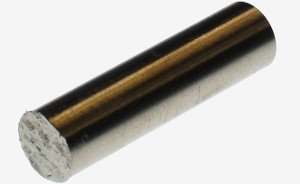
Zirconium rod. Image Ref. (1)
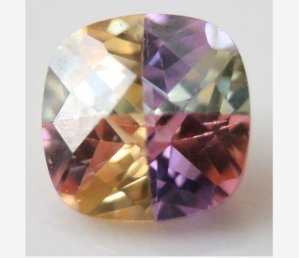
Cubic zirconia (shown above) has the same crystal structure as diamond, and has a similar sparkle. Image by Michelle Jo.

Appearance and Characteristics
Harmful effects:
Zirconium is considered to be non-toxic.
Characteristics:
Zirconium is a strong, malleable, ductile, lustrous, grayish-white metal.
When present in compounds, zirconium exists mostly in the oxidation state IV.
Its oxide (ZrO2) is white, like many of its compounds.
Zirconium is generally exceptionally resistant to corrosion. It is however rapidly attacked by hydrofluoric acid, even at low concentrations.
In an oxygen atmosphere, finely divided Zirconium burns with the highest known temperature for a metal flame: 4460 oC.(4) Powdered zirconium can spontaneously ignite in air.
Exposed surfaces of zirconium form a protective oxide layer.
Zirconium tungstate (ZrW2O8) is an unusual substance: it shrinks when heated from near absolute zero to 780 oC(5).
Uses of Zirconium
Zirconium is very poor at absorbing neutrons. It is therefore useful in nuclear energy applications such as in the cladding (outer layer) of fuel rods through which it is important that neutrons can travel easily.
Zirconium is used as to make surgical instruments and is used in steel alloys as a hardening agent.
As a result of its exceptional corrosion resistance, zirconium is used extensively in the chemical industry in corrosive environments where zirconium’s alloys can be found in pipes, fittings and heat exchangers.
Zirconium is also used to make superconductive magnets.
Zircon (zirconium silicate, ZrSiO4) is a natural gemstone and synthetic cubic zirconia (zirconium dioxide, ZrO2) is produced as a low-cost substitute for diamond.
Zirconium based catalysts are used in amination, hydrogenation, isomerization and oxidation reactions.
Lithium zirconate can be used to absorb carbon dioxide. The reaction is reversible so the carbon dioxide can be released in a location of choice and the lithium zirconate used again. This application may be useful in addressing environmental concerns about the release of carbon dioxide into the atmosphere.
Abundance and Isotopes
Abundance earth’s crust: 165 parts per million by weight, 38 parts per million by moles
Abundance solar system: 40 parts per billion by weight, 0.5 parts per billion by moles
Cost, pure: $157 per 100g
Cost, bulk: $16 per 100g
Source: Its chief mineral is zircon (zirconium silicate, ZrSiO4). It is produced commercially by reduction of the chloride with magnesium in the Kroll process.
Isotopes: Zirconium has 25 isotopes whose half-lives are known, with mass numbers 81 to 105. Naturally occurring zirconium is a mixture of five isotopes and they are found in the percentages shown: 90Zr (51.5%), 91Zr (11.2%), 92Zr (17.1%), 94Zr (17.4%) and 96Zr (2.8%). The most naturally abundant is 90Zr at 51.5%.
References
- Photo by Dschwen.
- Mary Elvira Weeks, The Discovery of the Elements XI., Journal of Chemical Education., July 1932, p1231/2.
- Edward Turner, Franklin Bache, Elements of Chemistry: Including the Recent Discoveries and Doctrines of the Science, 1830, John Grigg, p304/5.
- Mary Eagleson, Concise Encyclopedia Chemistry, 1994, Walter de Gruyter, page 1199.
- Allegheny Technologies Incorporated. Zirconium Tungstate. (pdf document).
Cite this Page
For online linking, please copy and paste one of the following:
<a href="https://www.chemicool.com/elements/zirconium.html">Zirconium</a>
or
<a href="https://www.chemicool.com/elements/zirconium.html">Zirconium Element Facts</a>
To cite this page in an academic document, please use the following MLA compliant citation:
"Zirconium." Chemicool Periodic Table. Chemicool.com. 18 Oct. 2012. Web. <https://www.chemicool.com/elements/zirconium.html>.
Thank you, this really helped for my report. Make more!
i really love doing this project it’s its such a big and fun project!!!! for me to go on this website it is awesome i lobe it