The chemical element thallium is classed as an other metal. It was discovered in 1861 by Sir William Crookes.

Data Zone
| Classification: | Thallium is an ‘other metal’ |
| Color: | silvery-gray |
| Atomic weight: | 204.383 |
| State: | solid |
| Melting point: | 304 oC, 577 K |
| Boiling point: | 1473 oC, 1746 K |
| Electrons: | 81 |
| Protons: | 81 |
| Neutrons in most abundant isotope: | 124 |
| Electron shells: | 2,8,18,32,18,3 |
| Electron configuration: | [Xe] 4f14 5d10 6s2 6p1 |
| Density @ 20oC: | 11.85 g/cm3 |
Reactions, Compounds, Radii, Conductivities
| Atomic volume: | 17.2 cm3/mol |
| Structure: | hcp: hexagonal close pkd |
| Hardness: | 1.2 mohs |
| Specific heat capacity | 0.13 J g-1 K-1 |
| Heat of fusion | 4.142 kJ mol-1 |
| Heat of atomization | 182 kJ mol-1 |
| Heat of vaporization | 164.10 kJ mol-1 |
| 1st ionization energy | 589.4 kJ mol-1 |
| 2nd ionization energy | 1971 kJ mol-1 |
| 3rd ionization energy | 2878 kJ mol-1 |
| Electron affinity | 36 kJ mol-1 |
| Minimum oxidation number | 0 |
| Min. common oxidation no. | 0 |
| Maximum oxidation number | 3 |
| Max. common oxidation no. | 3 |
| Electronegativity (Pauling Scale) | 1.83 |
| Polarizability volume | 7.6 Å3 |
| Reaction with air | mild, ⇒ Tl2O |
| Reaction with 15 M HNO3 | mild ⇒ TlNO3 |
| Reaction with 6 M HCl | – |
| Reaction with 6 M NaOH | – |
| Oxide(s) | Tl2O, Tl2O3 |
| Hydride(s) | – |
| Chloride(s) | TlCl, TlCl2, TlCl3 |
| Atomic radius | 190 pm |
| Ionic radius (1+ ion) | 164 pm |
| Ionic radius (2+ ion) | – |
| Ionic radius (3+ ion) | 102.5 pm |
| Ionic radius (1- ion) | – |
| Ionic radius (2- ion) | – |
| Ionic radius (3- ion) | – |
| Thermal conductivity | 46.1 W m-1 K-1 |
| Electrical conductivity | 5.6 x 10⁶ S m-1 |
| Freezing/Melting point: | 304 oC, 577 K |
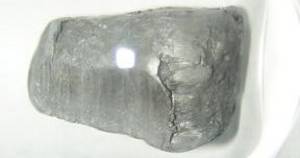
Thallium (Photo: Materialscientist)
Discovery of Thallium
Thallium was discovered by Sir William Crookes in 1861, in London.
In 1850 Crookes had been given a deposit containing selenium from a sulfuric acid factory in Tilkerode. He extracted the selenium and was left with residues which appeared to contain tellurium. (1)
Eleven years later, Crookes needed some tellurium. He remembered that he had once found what seemed to be tellurium in residues from sulfuric acid factory deposits, so he tried to do this again.
This time, however, he was unable to isolate any tellurium. Curious about why this should be, he decided to analyze the residues spectroscopically. He noticed a bright green line in the spectrum which he could not match with any known element. (1)
After many experiments, Crookes decided that the line was caused by a new element. He announced his discovery in March 1861 in Chemical News, a journal which he published and edited. (2)
Crookes found it difficult to thoroughly investigate thallium because he had such small amounts of it. Despite this, he made thallium salts and, he claimed, some grains of powdered metallic thallium to display at the London International Exhibition in 1862. (2)
Also at the exhibition was Claude-Auguste Lamy, who had independently discovered and isolated thallium in 1862, in France. Lamy had more thallium than Crookes, and presented an ingot of the pure metal at the exhibition. (3)
Crookes named thallium after the Greek word ‘thallos’ meaning a green shoot or twig, in reference to the unique green spectral line which identifies the element.
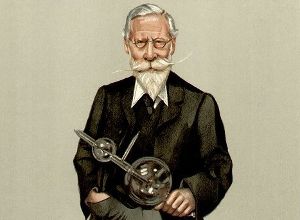
A 1902 caricature of Sir William Crookes, the discoverer of thallium. He is shown holding a Crookes tube, an electrical discharge tube which he invented.

Thallium’s emission spectrum. The previously unseen bright green line in a spectrum like this gave William Crookes the idea that he might have discovered a new element.
Like mercury and lead, thallium it is a soft, low melting point metal; for all three elements, the pure metal and its compounds are toxic. Metallic character increases as we look down Group 13. Boron is not a metal, it is a metalloid. Aluminum and gallium are amphoteric, dissolving in both acid and alkali solutions; indium and thallium are more metallic in that they do not dissolve in alkali solutions.
| Group 12 | Group 13 | Group 14 | |
| 5 | 48 Cd |
49 In |
50 Sn |
| 6 | 80 Hg |
81 Tl |
82 Pb |
| 7 | 113 Nh |
114 Fl |
115 Mc |

Between 1920 and 1972, thallium sulfate was widely used in rat poisons. The 1972 ban in the USA happened because thallium was killing unintended victims, including humans and bald eagles. One quarter of all sick or dead bald eagles in this era had suffered thallium poisoning.
Appearance and Characteristics
Harmful effects:
Thallium and its compounds are highly toxic. The average oral lethal dose is estimated to range from 10 to 15 mg of thallium per kg of body weight.
Agatha Christie made use of thallium’s toxicity in her novel The Pale Horse. One symptom the victims experienced, including one of the amateur investigators, was that their hair came out in clumps.
Characteristics:
Thallium is a very soft, malleable, lustrous low-melting, silvery metal that tarnishes in air to the bluish-gray oxide.
In appearance it resembles lead.
The metal can easily be cut with a knife.
It usually exists in the monovalent state, Tl+, in its compounds.
In the presence of water, the poisonous thallium hydroxide (TlOH) is formed.
Thallium dissolves slowly in hydrochloric acid and dilute sulfuric acid and dissolves rapidly in nitric acid.
Uses of Thallium
Thallium sulfate, which is odorless and colorless, was used as a rat poison and as an insecticide. This use has been discontinued in some countries, including the USA.
Thallium sulfide is used in photocells because its electrical conductivity increases on exposure to infrared light.
Thallium oxide is used to make glass that has a high index of refraction.
Thallium is also used in gamma radiation detection equipment.
Abundance and Isotopes
Abundance earth’s crust: 850 parts per billion by weight, 80 parts per billion by moles
Abundance solar system: 1 part per billion by weight, 10 parts per trillion by moles
Cost, pure: $48 per 100g
Cost, bulk: $ per 100g
Source: The main minerals containing thallium are crookesite (TlCu7Se4), hutchinsonite (TlPbAs5S9), and lorandite (TlAsS2).
Thallium also occurs in manganese nodules on the ocean floor.
Commercially, the metal is recovered as a by-product of sulfuric acid production as thallium is also present in pyrites (iron sulfide).
Thallium can also be obtained from the smelting of lead and zinc ores.
Isotopes: Thallium has 31 isotopes whose half-lives are known, with mass numbers from 179 to 210. Naturally occurring thallium is a mixture of its two stable isotopes, 203Tl and 205Tl with natural abundances of 29.5% and 70.5% respectively.
References
- William Crookes, On the Existence of a New Element, probably of the Sulphur Group, The Chemical News, Vol. III. No. 69., March 30 1861
- John Emsley, The Trouble with Thallium, New Scientist, Vol 79 No 1115, 10 August 1978, p392
- H.F.V. Little, A Textbook of Inorganic Chemistry. Volume IV. , 1917, Charles Griffin & Company Limited, p165
Cite this Page
For online linking, please copy and paste one of the following:
<a href="https://www.chemicool.com/elements/thallium.html">Thallium</a>
or
<a href="https://www.chemicool.com/elements/thallium.html">Thallium Element Facts</a>
To cite this page in an academic document, please use the following MLA compliant citation:
"Thallium." Chemicool Periodic Table. Chemicool.com. 24 Jul. 2015. Web. <https://www.chemicool.com/elements/thallium.html>.
Thanks for the information about thallium, it will be usefull for my ADOPT AN ELEMENT project for my science class.