The chemical element krypton is classed as a noble gas and a nonmetal. It was discovered in 1898 by William Ramsay and his assistant Morris Travers.

Data Zone
| Classification: | Krypton is a noble gas and a nonmetal |
| Color: | colorless |
| Atomic weight: | 83.80 |
| State: | gas |
| Melting point: | -157.3 oC, 115.9 K |
| Boiling point: | -153.2 oC, 119.4 K |
| Electrons: | 36 |
| Protons: | 36 |
| Neutrons in most abundant isotope: | 48 |
| Electron shells: | 2,8,18,8 |
| Electron configuration: | [Ar] 3d10 4s2 4p6 |
| Density @ 20oC: | 0.003708 g/cm3 |
Reactions, Compounds, Radii, Conductivities
| Atomic volume: | 38.9 cm3/mol |
| Structure: | fcc: face-centered cubic |
| Hardness: | – |
| Specific heat capacity | 0.248 J g-1 K-1 |
| Heat of fusion | 1.638 kJ mol-1 |
| Heat of atomization | 0 kJ mol-1 |
| Heat of vaporization | 9.029 kJ mol-1 |
| 1st ionization energy | 1350.7 kJ mol-1 |
| 2nd ionization energy | 2350.3 kJ mol-1 |
| 3rd ionization energy | 3565.1 kJ mol-1 |
| Electron affinity | – kJ mol-1 |
| Minimum oxidation number | 0 |
| Min. common oxidation no. | 0 |
| Maximum oxidation number | 2 |
| Max. common oxidation no. | 2 |
| Electronegativity (Pauling Scale) | 3 |
| Polarizability volume | 2.5 Å3 |
| Reaction with air | none |
| Reaction with 15 M HNO3 | none |
| Reaction with 6 M HCl | none |
| Reaction with 6 M NaOH | none |
| Oxide(s) | none |
| Hydride(s) | none |
| Chloride(s) | none |
| Atomic radius | 88 pm |
| Ionic radius (1+ ion) | – |
| Ionic radius (2+ ion) | – |
| Ionic radius (3+ ion) | – |
| Ionic radius (1- ion) | – |
| Ionic radius (2- ion) | – |
| Ionic radius (3- ion) | – |
| Thermal conductivity | 0.01 W m-1 K-1 |
| Electrical conductivity | – |
| Freezing/Melting point: | -157.3 oC, 115.9 K |
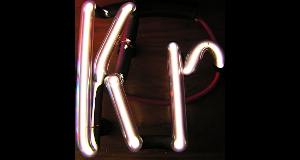
Krypton gas glows with the help of a few thousand volts. Image: Pslawinski.

Krypton’s Spectrum.
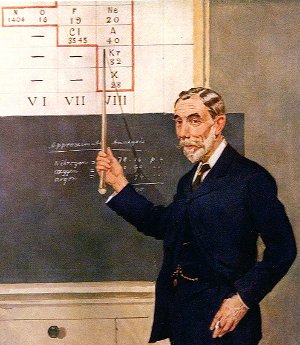
William Ramsay pointing to the periodic table’s final column containing the noble (or inert) gases. Ramsay was awarded the Nobel Prize for Chemistry in 1904 for his work in the discovery of the inert gases. Image: Vanity Fair
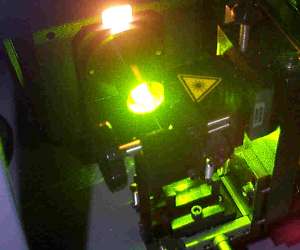
>A krypton-ion 568 nm tertiary laser used in protein research. Photo: Center for Cancer Research
Discovery of Krypton
Scottish chemist William Ramsay and his assistant English chemist Morris Travers discovered krypton in 1898 in London.
Ramsay had previously discovered helium and argon. He was aware that more new elements must lie in the same group of the periodic table.
Ramsay and Travers considered the gap in the periodic table between helium and argon. They reasoned that a new element (it’s now called neon) must exist to fill this gap; they were determined to find it. And find it they did, but only after their search had first revealed another new element: krypton. (1)
Aware of the history of chemistry, Ramsay knew that sometimes one new element can hide another. For example, Johan Gadolin had discovered yttrium in the mineral we now call gadolinite. Some years later Carl Gustaf Mosander discovered the new elements erbium and terbium in gadolinite; they had been there all along, but Gadolin had not found them. Ramsay wondered about the possibility of finding small amounts of the elusive new element hiding in one of his earlier discoveries, argon.
Ramsay and Travers decided they would extract a large volume of argon from air. They would liquefy the argon, and then distil it into separate fractions to see whether the lightest fractions contained the new gas. (2)
With little experience of handling liquid gases, they obtained a liter of liquid air in order to find out how to work with it. In their practice work, they evaporated most of it, leaving just 100 ml. Ramsay knew it was highly improbable the new gas, lighter than argon, could be present in this residual sample, but the exciting idea came to him that a new, heavier, gas might just be present.
With this in mind, Travers removed oxygen and nitrogen from the gas using red-hot copper and magnesium. He placed a sample of the remaining gas in a vacuum tube and applied a high voltage to measure the gas’s spectrum.
He found Argon was present, as expected, but also two new brilliant lines, one yellow and one green, which had never been seen before.
Ramsay and Travers measured the ratio of the gas’s specific heat at constant pressure to its specific heat at constant volume and found it was 1.66. This value could only be obtained if the new gas consisted of single atoms, proving it could not be a compound. If it was not a compound, it had to be a new element.
Krypton had been discovered. Ramsay chose the element’s name from the Greek word ‘kryptos’ meaning ‘hidden.’
For many years after the noble gases were discovered most scientists believed that they would not form compounds. This turned out to be incorrect.
William Ramsay actually did believe compounds would be possible, writing in 1902: “I have had for a long time the idea that krypton and xenon may enter into combinations much more easily than the other gases; but how to bring it about?” (3)
It took another 60 years before his question would be answered. (See Interesting Facts below.)
William Ramsay received the Nobel Prize for Chemistry in 1904, “in recognition of his services in the discovery of the inert gaseous elements in air, and his determination of their place in the periodic system.” He was responsible for adding an entire new group to the periodic table. Radon was the only noble gas he didn’t discover.
Interesting Facts about Krypton
-
Between 1960 and 1983, the scientific unit of length, the meter, was defined as 1 650 763.73 wavelengths of krypton-86’s orange-red spectral line. (The meter is now defined as the distance travelled by light in a vacuum during a time interval of
1/299 792 458 of a second.) - From its discovery in 1898 until the 1960s most scientists believed it was impossible to make compounds of krypton, or any other noble gas – although see William Ramsay, above. Krypton difluoride was made in 1963. It is a white, crystalline solid, stable at temperatures below -30 oC. (4)
- Krypton is not very abundant in our planet’s atmosphere: For every krypton atom, there are about 8200 argon atoms, 184 000 oxygen molecules and 685 000 nitrogen molecules.
- Krypton-85 in the atmosphere can be used to detect the presence of otherwise secret nuclear weapons research and production facilities. (5)
- Krypton-fluorine lasers produce pulses with 500 times the power of the entire U.S. electrical grid. Not surprisingly, these pulses are of short duration: four billionths of a second. (6)
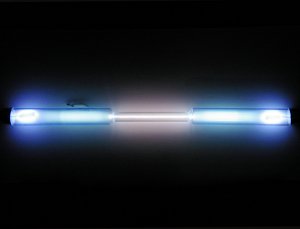
Krypton glowing at high voltage in an electrical discharge tube. Photo: Alchemist-hp
Appearance and Characteristics
Harmful effects:
Krypton is considered to be non-toxic.
Characteristics:
Krypton is a colorless, odorless, inert gas.
Although it is extremely unreactive krypton can react with the very reactive gas fluorine. A few compounds of krypton have been prepared, including krypton (II) fluoride and krypton clathrates.
Solid krypton is white and crystalline.
Uses of Krypton
Krypton is used in lighting products:
An important use is in high-powered, flashing airport runway lights.
Ionized krypton gas appears whitish – see photo on left – which makes krypton-based bulbs useful as a brilliant white light source in high speed photography.
Krypton is employed alongside other gases to make luminous ‘neon light‘ style signs that glow with a greenish-yellow light.
Krypton is used as a filling gas for energy-saving fluorescent lights and as an inert filling gas in incandescent bulbs.
The relative abundance of krypton versus hydrogen can be used by astronomers to measure how much nucleosynthesis (element formation) has taken place in any region of interstellar space. (7)
Between 1960 and 1983, an international agreement defined the meter length in terms of the wavelength of light emitted from the krypton isotope, 86Kr. (The meter is now defined as the distance traveled by light in vacuum during a time of 1/299,792,458 of a second. The time is measured using a cesium atomic clock.)
Abundance and Isotopes
Abundance earth’s crust: 100 parts per trillion by weight, 30 parts per trillion by moles
Abundance solar system: parts per million by weight, parts per million by moles
Cost, pure: $33 per 100g
Cost, bulk: $ per 100g
Source: Krypton is obtained commercially by fractional distillation of liquid air.
Isotopes: Krypton has 25 isotopes whose half-lives are known, with mass numbers 71 to 95. Naturally occurring krypton is a mixture of six isotopes and they are found in the percentages shown: 78Kr (0.4%), 80Kr (2.3%), 82Kr (11.6%), 83Kr (11.5%), 84Kr (57.0%) and 86Kr (17.3%). The most abundant isotope is 84Kr at 57.0%.
References
- William Ramsay, Nobel Prize Lecture., December 12, 1904.
- William Ramsay, The Recently Discovered Gases and Their Relation to the Periodic Law., Science, 1898, Vol. IX, p273-280.
- Leonello Paoloni, The noble gas compounds: the views of William Ramsay and Giuseppe Oddo in 1902., J. Chem. Educ., 1983, 60 (9), p758.
- D. R. MacKenzie, Krypton Difluoride: Preparation and Handling., Science 20 September 1963, Vol. 141 no. 3586 p1171.
- BBC Report, New N Korea nuclear plant suspected Sunday, 20 July, 2003.
- Naval Research Laboratory, Krypton-fluorine lasers.
- Stefan I. B. Cartledge et al., Interstellar Krypton Abundances: The Detection of Kiloparsec-scale Differences in Galactic Nucleosynthetic History., 2008, The Astrophysical Journal., 687, p1043.
Cite this Page
For online linking, please copy and paste one of the following:
<a href="https://www.chemicool.com/elements/krypton.html">Krypton</a>
or
<a href="https://www.chemicool.com/elements/krypton.html">Krypton Element Facts</a>
To cite this page in an academic document, please use the following MLA compliant citation:
"Krypton." Chemicool Periodic Table. Chemicool.com. 17 Oct. 2012. Web. <https://www.chemicool.com/elements/krypton.html>.
hiiii, i would really appriciate if you listed what family Krypton belongs to, other than that this website is greatttt.
Hi Katie, Krypton is one of the noble gases. 🙂
I love this website!!!!!!!
I have to do a project for school and it gave me EVERYTHING!!!!!!!!!!!!!!
IKR same with me i love this website
Hi I love this website it is awesome it helped me on my science project.
awesome website for my school project
Hey this website is great, it totally made my project easier.
hi i would be super happy if you said the group and period of krypton
The group is Noble Gases, and the period is 4.
Hope this helps you!
I love this website but what is kryptons mass number
Hi Nancy, to get the mass number, we add the number of protons and neutrons.
Krypton’s most abundant isotope has 48 neutrons, so its mass number is 36 + 48 = 84.
The next most abundant isotope is krypton-86, which has 50 neutrons and a mass number of 86.
wow this website completes my brochure project in science about krypton thanks 😉 😉
this helped me with my science project and I had all the info that I needed and I got and A+ on my project. I would always come to this website for all my science projects. 😉
Me to?
This website is great I love is! it gave me everything that I needed! Thanks!!!!!
Yup. This website does help a lot to clarify my doubts about the element I got assigned for a project. I recommend it to other students. My teacher assigned me krypton. It really helped me. I really don’t know much about krypton, but now I do. Thanks website.