The chemical element tellurium is classed as a chalcogen and a metalloid. It was discovered in 1798 by Martin H. Klaproth.

Data Zone
| Classification: | Tellurium is a chalcogen and a metalloid |
| Color: | silvery |
| Atomic weight: | 127.60 |
| State: | solid |
| Melting point: | 450 oC, 723 K |
| Boiling point: | 990 oC, 1263 K |
| Electrons: | 52 |
| Protons: | 52 |
| Neutrons in most abundant isotope: | 78 |
| Electron shells: | 2,8,18,18,6 |
| Electron configuration: | [Kr] 4d10 5s2 5p4 |
| Density @ 20oC: | 6.24 g/cm3 |
Reactions, Compounds, Radii, Conductivities
| Atomic volume: | 20.5 cm3/mol |
| Structure: | parallel chains |
| Hardness: | 2.3 mohs |
| Specific heat capacity | 0.20 J g-1 K-1 |
| Heat of fusion | 17.490 kJ mol-1 |
| Heat of atomization | 197 kJ mol-1 |
| Heat of vaporization | 52.550 kJ mol-1 |
| 1st ionization energy | 869.2 kJ mol-1 |
| 2nd ionization energy | 1794.6 kJ mol-1 |
| 3rd ionization energy | 2697.7 kJ mol-1 |
| Electron affinity | 190.16 kJ mol-1 |
| Minimum oxidation number | -2 |
| Min. common oxidation no. | 0 |
| Maximum oxidation number | 6 |
| Max. common oxidation no. | 6 |
| Electronegativity (Pauling Scale) | 2.1 |
| Polarizability volume | 5.5 Å3 |
| Reaction with air | mild, w/ht ⇒ TeO2 |
| Reaction with 15 M HNO3 | mild , ⇒ Te(IV) |
| Reaction with 6 M HCl | none |
| Reaction with 6 M NaOH | none |
| Oxide(s) | TeO (brown), TeO2 (white), TeO3 (orange/yellow) |
| Hydride(s) | TeH2 (hydrogen telluride) |
| Chloride(s) | Te2Cl, TeCl2, Te3Cl2, Te4Cl16 |
| Atomic radius | 142 pm |
| Ionic radius (1+ ion) | – |
| Ionic radius (2+ ion) | – |
| Ionic radius (3+ ion) | 90 pm |
| Ionic radius (1- ion) | – |
| Ionic radius (2- ion) | 207 pm |
| Ionic radius (3- ion) | – |
| Thermal conductivity | 3 W m-1 K-1 |
| Electrical conductivity | 0.0002 x 10⁶ S m-1 |
| Freezing/Melting point: | 450 oC, 723 K |
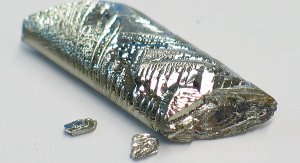
Crystalline tellurium. Image by Dschwen. (1)
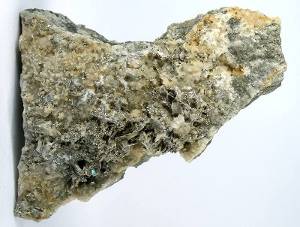
The mineral ore calaverite. Calaverite is also known as gold telluride, AuTe2. It is the mineral tellurium was discovered in. Image by Robert Lavinsky. (2)
Discovery of Tellurium
In the 1700s, scientists were confused by a substance found in various ores.
Although they could not isolate the substance, the properties of the ores seemed to indicate that that the substance had both metallic and non-metallic properties.
They called the new substance ‘aurum paradoxum’ meaning paradoxical/illogical gold or ‘metallum problematum’ meaning problem metal.
In 1782, Austro-Hungarian mineralogist Baron Franz Muller von Reichenstein purified a substance, which he believed to contain antimony, from a Transylvanian gold ore. (We now know this ore was actually gold telluride, AuTe2, often known as calaverite.)
Muller came to believe that his initial thoughts were wrong and that he might be dealing with a new element. (3)
He sent a small sample to Torbern Bergman in Uppsala, Sweden, who replied in April 1784, agreeing that the substance did not contain antimony. Bergman asked for more samples so that he could study the substance further, but he died in July of that year. (4)
Twelve years later, Muller sent a sample to Martin H. Klaproth in Berlin, who isolated the tellurium. In 1798, Klaproth publicly confirmed the existence of a new element in the sample sent to him by Muller.
Klaproth named the new element tellurium. The name comes from the Latin word ‘tellus’ meaning Earth.
It took a further 34 years for the chemistry of tellurium to be investigated.
In 1832, in Stockholm, Sweden, Jons Jacob Berzelius made a detailed study of the element and its compounds. He decided that tellurium was a metal, but belonged in the same group as the nonmetals sulfur and selenium due to the similarities of their compounds. (5)
We now class tellurium as a metalloid because, as the confused scientists of the 1700s first noticed, it has properties that sit between those of metals and nonmetals.

Hubble Telescope Wide Field Camera 3. The crystalline photosensitive surface of the camera’s near-infrared detector is composed of mercury, cadmium and tellurium (HgCdTe). (NASA)
Tellurium is a metalloid. It sits in the periodic table on the boundary between metals and nonmetals. Its behavior also sits between that of metals and nonmetals.
| Group 15 | Group 16 | Group 17 | |
| Row 4 | 33 As |
34 Se |
35 Br |
| Row 5 | 51 Sb |
52 Te |
53 I |
| Row 6 | 83 Bi |
84 Po |
85 At |

Cadmium telluride (CaTe) is used as a thin film in solar panels, converting sunlight to electricity. These solar panels are more efficient than amorphous silicon alternatives. Image from NREL.
Appearance and Characteristics
Harmful effects:
Tellurium is very toxic and teratogenic (can cause harm to developing embryos). Exposure to as little as 0.01 mg/m2 or less in air leads to “tellurium breath”, which has a garlic-like odor.
Characteristics:
Tellurium is a rare, silvery-white, brittle, lustrous metalloid.
It burns in air with a greenish-blue flame and forms white tellurium dioxide (TeO2).
When present in compounds, tellurium exists mostly in the oxidation state IV and VI.
Tellurium is a semiconductor material and is slightly photosensitive.
It forms many compounds corresponding to those of sulfur and selenium, the elements above it in the periodic table. For example, it forms tellurides with other metals and tellurite (TeO32-) and tellurate (TeO42-) compounds.
Tellurium has radioactive isotopes and is the lightest element to exhibit alpha decay.
Uses of Tellurium
Tellurium is alloyed with copper and stainless steel to make these metals more workable.
It is added at very low levels to lead to decreases the corrosive action of sulfuric acid in batteries and to improve the lead’s strength and hardness.
Tellurium is used as a coloring agent in ceramics.
Tellurium is also used in the electronics industry, for example with cadmium and mercury to form photosensitive semiconductors. Cadmium telluride (CdTe) is used as a thin film in solar panels to convert sunlight into electricity. CdTe panels have an efficiency rating of between 11 and 13 percent compared to amorphous silicon solar panels which have an efficiency of between 7 to 9 percent. (6)
It is used in vulcanizing rubber and in catalysts for petroleum cracking and in blasting caps for explosives.
Abundance and Isotopes
Abundance earth’s crust: 1 part per billion by weight, 0.2 parts per billion by moles
Abundance solar system:
Cost, pure: $24 per 100g
Cost, bulk: $0.44 per 100g
Source: Tellurium is sometimes found free in nature. More commonly, it is found combined with metals, such as in the minerals calaverite (gold telluride, AuTe2) and sylvanite (silver-gold telluride). Commercially, tellurium is obtained as a byproduct of electrolytic copper refining.
Isotopes: Tellurium has 33 isotopes whose half-lives are known, with mass numbers 106 to 138. Naturally occurring tellurium is a mixture of eight isotopes and they are found in the percentages shown: 120Te (0.1%), 122Te (2.6%), 123Te (0.9%), 124Te (4.8%), 125Te (7.1%), 126Te (19.0%), 128Te (31.7%), and 130Te (33.8%).
References
- Image by Dschwen
- Image by Rob Lavinski / iRocks.com
- Mary Elvira Weeks, The Discovery of the Elements VI. Tellurium and Selenium, Journal of Chemical Education., March 1932, p474.
- Per Enghag, Encyclopedia of the Elements: Technical Data – History – Processing – Applications, 2008, John Wiley & Sons, p1067
- B. Smith Hopkins, Chemistry of the Rarer Elements, 1923, D.C. Heath and Company, p327
- MIT OpenCourseWare, 3.003 Principles of Engineering Practice, 2010 (pdf).
Cite this Page
For online linking, please copy and paste one of the following:
<a href="https://www.chemicool.com/elements/tellurium.html">Tellurium</a>
or
<a href="https://www.chemicool.com/elements/tellurium.html">Tellurium Element Facts</a>
To cite this page in an academic document, please use the following MLA compliant citation:
"Tellurium." Chemicool Periodic Table. Chemicool.com. 18 Oct. 2012. Web. <https://www.chemicool.com/elements/tellurium.html>.
Isn’t tellurium 128 the most common isotope, making the number of neutrons 76?
Thanks for your question Caroline.
Tellurium-128 does indeed have 76 neutrons, but it isn’t the commonest isotope. The commonest isotope is tellurium-130 with 78 neutrons.
Tellurium has 33 isotopes whose half-lives are known, with mass numbers 106 to 138. Naturally occurring tellurium is a mixture of eight isotopes and they are found in the percentages shown: 120Te (0.1%), 122Te (2.6%), 123Te (0.9%), 124Te (4.8%), 125Te (7.1%), 126Te (19.0%), 128Te (31.7%), and 130Te (33.8%).