The chemical element platinum is classed as a transition metal. It was discovered by South American peoples.

Data Zone
| Classification: | Platinum is a transition metal |
| Color: | silvery-white |
| Atomic weight: | 195.08 |
| State: | solid |
| Melting point: | 1768 oC, 2041 K |
| Boiling point: | 3820 oC, 4093 K |
| Electrons: | 78 |
| Protons: | 78 |
| Neutrons in most abundant isotope: | 117 |
| Electron shells: | 2, 8, 18, 32, 17, 1 |
| Electron configuration: | [Xe] 4f14 5d9 6s1 |
| Density @ 20oC: | 21.45 g/cm3 |
Reactions, Compounds, Radii, Conductivities
| Atomic volume: | 9.10 cm3/mol |
| Structure: | fcc: face-centered cubic |
| Hardness: | 3.5 mohs |
| Specific heat capacity | 0.13 J g-1 K-1 |
| Heat of fusion | 22.17 kJ mol-1 |
| Heat of atomization | 564 kJ mol-1 |
| Heat of vaporization | 510.45 kJ mol-1 |
| 1st ionization energy | 870 kJ mol-1 |
| 2nd ionization energy | 1791 kJ mol-1 |
| 3rd ionization energy | – |
| Electron affinity | 205.3 kJ mol-1 |
| Minimum oxidation number | 0 |
| Min. common oxidation no. | 0 |
| Maximum oxidation number | 6 |
| Max. common oxidation no. | 4 |
| Electronegativity (Pauling Scale) | 2.28 |
| Polarizability volume | 6.5 Å3 |
| Reaction with air | none |
| Reaction with 15 M HNO3 | none |
| Reaction with 6 M HCl | none |
| Reaction with 6 M NaOH | none |
| Oxide(s) | Pt2O2 |
| Hydride(s) | – |
| Chloride(s) | PtCl2, PtCl4 |
| Atomic radius | 135 pm |
| Ionic radius (1+ ion) | – |
| Ionic radius (2+ ion) | 94 pm |
| Ionic radius (3+ ion) | – |
| Ionic radius (1- ion) | – |
| Ionic radius (2- ion) | – |
| Ionic radius (3- ion) | – |
| Thermal conductivity | 71.6 W m-1 K-1 |
| Electrical conductivity | 9.4 x 10⁶ S m-1 |
| Freezing/Melting point: | 1768 oC, 2041 K |
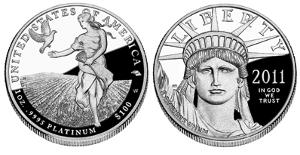
Both sides of a platinum eagle coin.
Discovery of Platinum
Platinum was discovered by South American peoples who produced artifacts of a white gold-platinum alloy.
The first written account of platinum was from Julius C Scaliger in 1557. He describes it as a strange metal found in mines between Panama and Mexico and wrote that no fire or any of the Spanish arts could melt it.
In 1783 French chemist Francois Chabaneaus discovered and patented a method of producing workable platinum. However the quality of the metal was still very inconsistent from batch to batch – unknown to him, there were impurities of, as then, undiscovered metals.
English chemist William H Wollaston developed a commercial process for producing pure platinum in the early 19th century. In the course of his studies on platinum ores he also discovered the metals osmium, iridium, rhodium and palladium – the elements which had made Chabaneaus’ work so frustrating.
The element name comes from the Spanish word ‘platina’ meaning little silver.
Appearance and Characteristics
Harmful effects:
Platinum is considered to be non-toxic.
Characteristics:
Platinum is a precious metal; soft, silvery-white, and dense with a beautiful lustrous sheen.
It is one of the of the six platinum group metals consisting of platinum, palladium, rhodium, osmium, iridium and ruthenium.
The Platinum Group Metals
These metals have similar properties and are often present in the same mineral ores.
| 44 Ru |
45 Rh |
46 Pd |
| 76 Os |
77 Ir |
78 Pt |
Platinum is malleable and ductile and has a high melting point.
It does not oxidize in air even at high temperatures and is unaffected by common acids.
Platinum dissolves in aqua regia (mixture of nitric acid and hydrochloric acid in the ratio 1:3) forming chloroplatinic acid (H2PtCl6).
It is also corroded by halogens, cyanides, sulfur, and caustic alkalis.
Uses of Platinum
Platinum is widely used as a catalyst for chemical reactions. The most important use of platinum is in vehicles, as a catalytic converter, facilitating the complete combustion of unburned hydrocarbon passing through the exhaust.
Platinum is used in jewelry, decoration and dental work. The metal and its alloys are also used for electrical contacts, fine resistance wires and medical / laboratory instruments.
An alloy of platinum and cobalt is used to produce strong permanent magnets.
The metal is also used to make electrodes sealed in glass (as its thermal coefficient of expansion is almost equal to that of glass).
Abundance and Isotopes
Abundance earth’s crust: 5 parts per billion by weight, 0.5 parts per billion by moles
Abundance solar system: 9 part per billion by weight, 0.06 parts per billion by moles
Cost, pure: $13000 per 100g
Cost, bulk: $5000 per 100g
Source: Platinum is an extremely rare metal and can be found uncombined in alluvial deposits often accompanied by small amounts of other platinum family metals. A major source of platinum is the ore sperrylite (PtAs2). It is also found in the mineral cooperite (PtS). Platinum is also produced commercially as a by-product of nickel refining from copper-nickel ores.
Isotopes: Platinum has 35 isotopes whose half-lives are known, with mass numbers 202 to 168. Naturally occurring platinum is a mixture of six isotopes and they are found in the percentages shown: 190Pt (0.01%), 192Pt (0.78%), 194Pt (33.0%), 195Pt (33.8%), 196Pt (25.2%) and 198Pt (7.2%). The most abundant is 195Pt at 33.8%.
References
Cite this Page
For online linking, please copy and paste one of the following:
<a href="https://www.chemicool.com/elements/platinum.html">Platinum</a>
or
<a href="https://www.chemicool.com/elements/platinum.html">Platinum Element Facts</a>
To cite this page in an academic document, please use the following MLA compliant citation:
"Platinum." Chemicool Periodic Table. Chemicool.com. 24 Jul. 2015. Web. <https://www.chemicool.com/elements/platinum.html>.
this website really helped me with my science project