The chemical element copper is classed as a transition metal. It has been known since ancient times. Its discoverer and discovery date are unknown.

Data Zone
| Classification: | Copper is a transition metal |
| Color: | orange-red |
| Atomic weight: | 63.546 |
| State: | solid |
| Melting point: | 1084.62 oC, 1357.77 K |
| Boiling point: | 2560 oC, 2833 K |
| Electrons: | 29 |
| Protons: | 29 |
| Neutrons in most abundant isotope: | 34 |
| Electron shells: | 2,8,18,1 |
| Electron configuration: | [Ar] 3d10 4s1 |
| Density @ 20oC: | 8.96 g/cm3 |
Compounds, Radii, Conductivities
| Atomic volume: | 7.1 cm3/mol |
| Structure: | fcc: face-centered cubic |
| Hardness: | 3.0 mohs |
| Specific heat capacity | 0.38 J g-1 K-1 |
| Heat of fusion | 13.050 kJ mol-1 |
| Heat of atomization | 338 kJ mol-1 |
| Heat of vaporization | 300.30 kJ mol-1 |
| 1st ionization energy | 745.4 kJ mol-1 |
| 2nd ionization energy | 1957.9 kJ mol-1 |
| 3rd ionization energy | 3553.5 kJ mol-1 |
| Electron affinity | 118.5 kJ mol-1 |
| Minimum oxidation number | 0 |
| Min. common oxidation no. | 0 |
| Maximum oxidation number | 4 |
| Max. common oxidation no. | 2 |
| Electronegativity (Pauling Scale) | 1.95 |
| Polarizability volume | 6.7 Å3 |
| Reaction with air | mild, w/ht ⇒ CuO, Cu2O |
| Reaction with 15 M HNO3 | mild, ⇒ Cu(NO3)2, NOx |
| Reaction with 6 M HCl | none |
| Reaction with 6 M NaOH | – |
| Oxide(s) | CuO, Cu2O (cuprite) |
| Hydride(s) | CuH |
| Chloride(s) | CuCl, CuCl2 |
| Atomic radius | 135 pm |
| Ionic radius (1+ ion) | 91 pm |
| Ionic radius (2+ ion) | 87 pm |
| Ionic radius (3+ ion) | 68 pm |
| Ionic radius (1- ion) | – |
| Ionic radius (2- ion) | – |
| Ionic radius (3- ion) | – |
| Thermal conductivity | 401 W m-1 K-1 |
| Electrical conductivity | 60.7 x 10⁶ S m-1 |
| Freezing/Melting point: | 1084.62 oC, 1357.77 K |
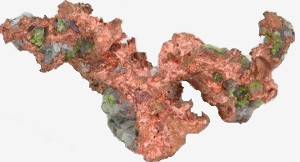
A nugget of natural, native copper with imbedded copper minerals
Discovery of Copper
Of all the metals, copper is the one most likely to be found in its native state, often released by the chemical reaction of its ores.
Although only small amounts of native copper can be found, there was enough of it for our ancestors to discover the metal and begin using it.
Copper has been used by humans for as many as ten thousand years. Beads made from native copper dating from the eighth millennium BC have been found in Turkey. (1)
Crucibles and slags found in Europe suggest that smelting of copper (producing the metal from its ores) took place in the fifth millennium BC.
Copper mining and smelting were commonplace by 4500 BC in the Balkans – Bulgaria, Greece, Serbia and Turkey. (2), (3)
The Copper Age sits between the Neolithic (Stone) and Bronze Ages. It took place at different times in different cultures, when people began using copper tools alongside stone tools.
The Copper Age was followed by the Bronze Age, when people learned that by adding tin to copper, a harder metal that is also more easily cast was formed. Again this happened at different times in different locations in the world.
The word copper is derived from the Latin word ‘cuprum’ meaning ‘metal of Cyprus’ because the Mediterranean island of Cyprus was an ancient source of mined copper.
The element symbol Cu also comes from ‘cuprum.’ (4)
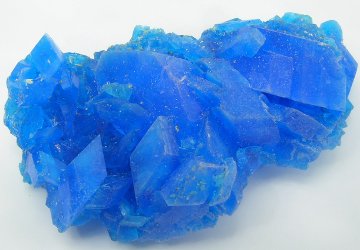
Growing copper sulfate crystals is cool – chemicool in fact.

Verdigris (corroded copper) on rooftop decorations.
Appearance and Characteristics
Harmful effects:
Copper is essential in all plants and animals. Excess copper is, however, toxic.
Cooking acidic food in copper pots can cause toxicity. Copper cookware should be lined to prevent ingestion of toxic verdigris (compounds formed when copper corrodes).
Characteristics:
Copper is a reddish orange, soft metal that takes on a bright metallic luster.
It is malleable, ductile, and an excellent conductor of heat and electricity – only silver has a higher electrical conductivity than copper.
Copper surfaces exposed to air gradually tarnish to a dull, brownish color.
If water and air are present, copper will slowly corrode to form the carbonate verdigris often seen on roofs and statues.
Uses of Copper
As a result of its excellent electrical conductivity, copper’s most common use is in electrical equipment such as wiring and motors.
Because it corrodes slowly, copper is used in roofing, guttering, and as rainspouts on buildings.
It is also used in plumbing and in cookware and cooking utensils.
Commercially important alloys such as brass and bronze are made with copper and other metals.
Gun metals and American coins are copper alloys.
Copper sulfate is used as a fungicide and as an algicide in rivers, lakes and ponds.
Copper oxide in Fehling’s solution is widely used in tests for the presence of monosaccharides (simple sugars).
Abundance and Isotopes
Abundance earth’s crust: 60 parts per million by weight, 19 parts per million by moles
Abundance solar system: 700 parts per billion by weight, 10 parts per billion by moles
Cost, pure: $9.76 per 100g
Cost, bulk: $0.66 per 100g
Source: Copper is occasionally found native (i.e. as the uncombined metal), and is also found in many minerals such as the oxide; cuprite (Cu2O), the carbonates; malachite (Cu2CO3(OH)2)and azurite (Cu2(CO3)2(OH)2) and the sulfides; chalcopyrite (CuFeS2) and bornite (Cu5FeS4).
Most copper ore is mined or extracted as copper sulfides. Copper is then obtained by smelting and leaching. Finally, the resulting crude copper is purified by electrolysis involving plating onto pure copper cathodes.
Isotopes: Copper has 24 isotopes whose half-lives are known, with mass numbers 57 to 80. Naturally occurring copper is a mixture of its two stable isotopes, 63Cu and 65Cu, with natural abundances of 69.2% and 30.8% respectively.
References
- Andrew Jones, Prehistoric Europe: Theory and Practice., 2008, p195. Blackwell Publishing.
- Douglass Whitfield Bailey, Balkan Prehistory: Exclusion, Incorporation and Identity, 2000, p210. Routledge.
- Sarunas Milisauskas, European Prehistory., 2003, p207. Kluwer Academic/Plenum.
- Saul S. Hauben, The derivations of the names of the elements, J. Chem. Educ., 1933, 10 (4), p227.
Cite this Page
For online linking, please copy and paste one of the following:
<a href="https://www.chemicool.com/elements/copper.html">Copper</a>
or
<a href="https://www.chemicool.com/elements/copper.html">Copper Element Facts</a>
To cite this page in an academic document, please use the following MLA compliant citation:
"Copper." Chemicool Periodic Table. Chemicool.com. 16 Oct. 2012. Web. <https://www.chemicool.com/elements/copper.html>.
copper will kill sheep, which is why sheep and goat food are different