The chemical element strontium is classed as an alkali earth metal. It was discovered in 1790 by Adair Crawford.

Data Zone
| Classification: | Strontium is an alkali earth metal |
| Color: | silvery |
| Atomic weight: | 87.62 |
| State: | solid |
| Melting point: | 777 oC, 1050 K |
| Boiling point: | 1380 oC, 1653 K |
| Electrons: | 38 |
| Protons: | 38 |
| Neutrons in most abundant isotope: | 50 |
| Electron shells: | 2,8,18,8,2 |
| Electron configuration: | [Kr] 5s2 |
| Density @ 20oC: | 2.6 g/cm3 |
Reactions, Compounds, Radii, Conductivities
| Atomic volume: | 33.7 cm3/mol |
| Structure: | ccp: cubic close-packed |
| Hardness: | 1.5 mohs |
| Specific heat capacity | 0.30 J g-1 K-1 |
| Heat of fusion | 8.30 kJ mol-1 |
| Heat of atomization | 164 kJ mol-1 |
| Heat of vaporization | 144.0 kJ mol-1 |
| 1st ionization energy | 549.5 kJ mol-1 |
| 2nd ionization energy | 1064.2 kJ mol-1 |
| 3rd ionization energy | 4138 kJ mol-1 |
| Electron affinity | 5 kJ mol-1 |
| Minimum oxidation number | 0 |
| Min. common oxidation no. | 0 |
| Maximum oxidation number | 2 |
| Max. common oxidation no. | 2 |
| Electronegativity (Pauling Scale) | 0.95 |
| Polarizability volume | 27.6 Å3 |
| Reaction with air | vigorous, ⇒ SrO, Sr2N3 |
| Reaction with 15 M HNO3 | vigorous, ⇒ H2, Sr(NO3)2 |
| Reaction with 6 M HCl | vigorous, ⇒ H2, SrCl2 |
| Reaction with 6 M NaOH | vigorous, ⇒ none |
| Oxide(s) | SrO, SrO2 (strontium peroxide) |
| Hydride(s) | SrH2 |
| Chloride(s) | SrCl2 |
| Atomic radius | 200 pm |
| Ionic radius (1+ ion) | – |
| Ionic radius (2+ ion) | 132 pm |
| Ionic radius (3+ ion) | – |
| Ionic radius (1- ion) | – |
| Ionic radius (2- ion) | – |
| Ionic radius (3- ion) | – |
| Thermal conductivity | 35.4 W m-1 K-1 |
| Electrical conductivity | 5 x 10⁶ S m-1 |
| Freezing/Melting point: | 777 oC, 1050 K |
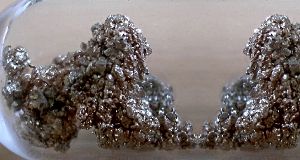
Strontium. Photo by Matthias Zepper.
Discovery of Strontium
Strontium was recognized as a new element in 1790 when Adair Crawford analyzed a mineral sample from a lead mine near Strontian, Scotland. Until then scientists had thought strontium and barium were the same element, and only barium’s existence had been recognized.
The mineral took its name from the Scottish town and was called strontianite (strontium carbonate).
Strontium metal was first isolated in 1808 by Sir Humphry Davy working in London using electrolysis.
Davy had built a very large 600-plate battery, which he used to pass electricity through salts, breaking them down in order to isolate new elements.
He mixed magnesium oxide to a paste with (probably) strontium sulfate. He made a depression in the paste and placed mercury metal there to act as an electrode. Platinum was used as a counter electrode.
When electricity was passed through the paste, a strontium-mercury amalgam formed at the mercury electrode.
Davy removed the mercury from the amalgam by heating it to leave strontium metal. (1),(2).
The element was named strontium by Davy after the mineral it was produced from.
Davy discovered or isolated for the first time several alkali and alkali earth metals including potassium, sodium, barium, calcium and magnesium.
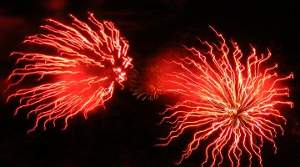
Strontium nitrate produces a red color in pyrotechnic displays. Strontium is the source of the red color.
Appearance and Characteristics
Harmful effects:
Strontium’s non-radioactive isotopes are considered non-toxic.
Characteristics:
Strontium is a soft, silvery metal. When cut it quickly turns a yellowish color due to the formation of strontium oxide (strontia, SrO). Finely powdered strontium metal is sufficiently reactive to ignite spontaneously in air.
It reacts with water quickly (but not violently like the Group 1 metals) to produce strontium hydroxide and hydrogen gas.
Strontium and its compounds burn with a crimson flame and are used in fireworks.
Strontium’s Periodic Table Neighborhood
Strontium is a Group 2 Alkaline earth metal. It usually exists as a divalent ion, Sr2+, in its compounds. Strontium’s chemistry is very similar to that of calcium, which sits above it in Group 2.
| Group 1 | Group 2 | Group 3 | |
| 4 | 19 K |
20 Ca |
21 Sc |
| 5 | 37 Rb |
38 Sr |
39 Y |
| 6 | 55 Cs |
56 Ba |
57 La |
Uses of Strontium
Strontium is used for producing glass (cathode ray tubes) for color televisions. It is also used in producing ferrite ceramic magnets and in refining zinc.
The world’s most accurate atomic clock, accurate to one second in 200 million years, has been developed using strontium atoms.
Strontium salts are used in flares and fireworks for a crimson color.
Strontium chloride is used in toothpaste for sensitive teeth.
Strontium oxide is used to improve the quality of pottery glazes.
The isotope 90Sr is one of the best long-lived, high-energy beta emitters known. It is used in cancer therapy.
Abundance and Isotopes
Abundance earth’s crust: 370 parts per million by weight, 87 parts per million by moles
Abundance solar system: 50 parts per billion by weight, 0.7 parts per billion by moles
Cost, pure: $100 per 100g
Cost, bulk: $ per 100g
Source: Strontium is never found free in nature. The principal strontium ores are celestine (strontium sulfate, SrSO4) and strontianite (strontium carbonate, SrCO3). The main commercial process for strontium metal production is reduction of strontium oxide with aluminum.
Isotopes: Strontium has 28 isotopes whose half-lives are known, with mass numbers 75 to 102. Naturally occurring strontium is a mixture of its four stable isotopes and they are found in the percentages shown: 84Sr (0.6%), 86Sr (9.9%), 87Sr (7.0%) and 88Sr (82.6%).
References
- Mary Elvira Weeks, Discovery of the Elements., Journal of Chemical Education (June 1932) p1046.
- T. K. Kenyon, Science and Celebrity: Humphry Davy’s Rising Star., Chemical Heritage Magazine, (2008/9 edition).
Cite this Page
For online linking, please copy and paste one of the following:
<a href="https://www.chemicool.com/elements/strontium.html">Strontium</a>
or
<a href="https://www.chemicool.com/elements/strontium.html">Strontium Element Facts</a>
To cite this page in an academic document, please use the following MLA compliant citation:
"Strontium." Chemicool Periodic Table. Chemicool.com. 24 Jul. 2015. Web. <https://www.chemicool.com/elements/strontium.html>.
This is all the info I needed, so awesome! Thank-you sooooo much!
this is all i need for a paper thanks