The chemical element gallium is classed as an other metal. It was discovered in 1875 by Paul E. Lecoq de Boisbaudran.

Data Zone
| Classification: | Gallium is an ‘other metal’ |
| Color: | silvery-blue |
| Atomic weight: | 69.723 |
| State: | solid |
| Melting point: | 29.76 oC, 302.91 K |
| Boiling point: | 2200 oC, 2473 K |
| Electrons: | 31 |
| Protons: | 31 |
| Neutrons in most abundant isotope: | 40 |
| Electron shells: | 2,8,18,3 |
| Electron configuration: | [Ar] 3d10 4s2 4p1 |
| Density @ 20oC: | 5.907 g/cm3 |
Reactions, Compounds, Radii, Conductivities
| Atomic volume: | 11.8 cm3/mol |
| Structure: | orthorhombic |
| Hardness: | 1.5 mohs |
| Specific heat capacity | 0.37 J g-1 K-1 |
| Heat of fusion | 5.590 kJ mol-1 |
| Heat of atomization | 277 kJ mol-1 |
| Heat of vaporization | 258.70 kJ mol-1 |
| 1st ionization energy | 578.8 kJ mol-1 |
| 2nd ionization energy | 1979.3 kJ mol-1 |
| 3rd ionization energy | 2963 kJ mol-1 |
| Electron affinity | 41 kJ mol-1 |
| Minimum oxidation number | 0 |
| Min. common oxidation no. | 0 |
| Maximum oxidation number | 3 |
| Max. common oxidation no. | 3 |
| Electronegativity (Pauling Scale) | 1.81 |
| Polarizability volume | 8.1 Å3 |
| Reaction with air | mild, ⇒ Ga2O3 |
| Reaction with 15 M HNO3 | – |
| Reaction with 6 M HCl | mild, ⇒ H2, GaCl3 |
| Reaction with 6 M NaOH | mild, ⇒ H2, [Ga(OH4)]2- |
| Oxide(s) | Ga2O3 |
| Hydride(s) | GaH3 |
| Chloride(s) | GaCl, Ga2Cl6 |
| Atomic radius | 135 pm |
| Ionic radius (1+ ion) | – |
| Ionic radius (2+ ion) | – |
| Ionic radius (3+ ion) | 76 pm |
| Ionic radius (1- ion) | – |
| Ionic radius (2- ion) | – |
| Ionic radius (3- ion) | – |
| Thermal conductivity | 40.6 W m-1 K-1 |
| Electrical conductivity | 1.8 x 10⁶ S m-1 |
| Freezing/Melting point: | 29.76 oC, 302.91 K |
Discovery of Gallium
Before the discovery of gallium its existence and main properties were predicted by Russian chemist Dmitri Mendeleev. He named the hypothetical element eka-aluminum as he predicted the element would sit below aluminum on the periodic table.
Gallium was discovered by French chemist Paul E. Lecoq de Boisbaudran through a spectroscope in 1875 in Paris.
Its now characteristic spectrum (two violet lines) identified it as a new element.
De Boisbaudran extracted gallium in the first instance from a zinc blende ore from the Pyrenees and obtained initially only 0.65 grams from 430 kilograms of ore. He isolated gallium by electrolysis of its hydroxide in potassium hydroxide solution.
The origin of the name comes from the Latin word ‘Gallia’, meaning France.
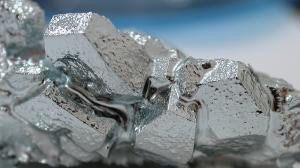
The photo below shows Crystals of gallium metal. Image Ref (1).
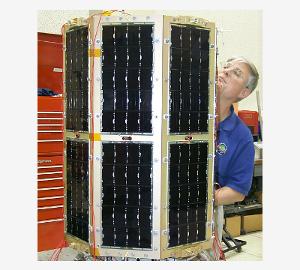
High-efficiency, triple-junction gallium arsenide solar cells cover the sides of U.S. Naval Academy satellite MidSTAR-1 (Photo: NASA)
Appearance and Characteristics
Harmful effects:
Gallium is considered to be non-toxic.
Characteristics:
Gallium is a silvery, glass-like, soft metal. It sits close to the non-metals in the periodic table and its metallic properties aren’t as obviously metallic as most other metals. Solid gallium is brittle and is a poorer electrical conductor than lead.
The solid metal fractures conchoidally. (Conchoidally means like a shell – the fractured surfaces are curved like a sea shell.)
Gallium has the second largest liquid range of any element and is one of the few metals that is liquid near room temperature (m.pt. 29.76 oC, 85.6 oF ), melting in the hand.
The other metals with this property are cesium, francium and mercury.
Bromine is the only non-metallic element that is liquid at or around room-temperature.
Gallium liquid clings to or wets glass and similar surfaces.
Gallium also has the unusual property that (like water) it expands as it freezes.
Four other elements expand when they freeze; silicon, bismuth, antimony and germanium
Uses of Gallium
Low melting gallium alloys are used in some medical thermometers as non-toxic substitutes for mercury.
Gallium arsenide is used in semiconductor production mainly for laser diodes, light-emitting diodes and solar panels. It is also used to create brilliant mirrors.
Abundance and Isotopes
Abundance earth’s crust: 19 parts per million by weight, 5.5 parts per million by moles
Abundance solar system: 40 parts per billion by weight, 0.6 parts per billion by moles
Cost, pure: $220 per 100g
Cost, bulk: $ per 100g
Source: Gallium does not exist free in nature and there are no minerals with any substantial gallium content. Commercially, most gallium is extracted as a byproduct of aluminum and zinc production. Gallium is also extracted from the flue dusts of coal.
Isotopes: Gallium has 24 isotopes whose half-lives are known, with mass numbers 61 to 84. Of these, two are stable: 69Ga and 71Ga with natural abundances of 60.1% and 39.9% respectively.
References
- Photo by Foobar, GNU FD.
Cite this Page
For online linking, please copy and paste one of the following:
<a href="https://www.chemicool.com/elements/gallium.html">Gallium</a>
or
<a href="https://www.chemicool.com/elements/gallium.html">Gallium Element Facts</a>
To cite this page in an academic document, please use the following MLA compliant citation:
"Gallium." Chemicool Periodic Table. Chemicool.com. 17 Oct. 2012. Web. <https://www.chemicool.com/elements/gallium.html>.
thanks good info for my project
Thanks for the helpful stuff!
Great Information! Perfect for my Project.